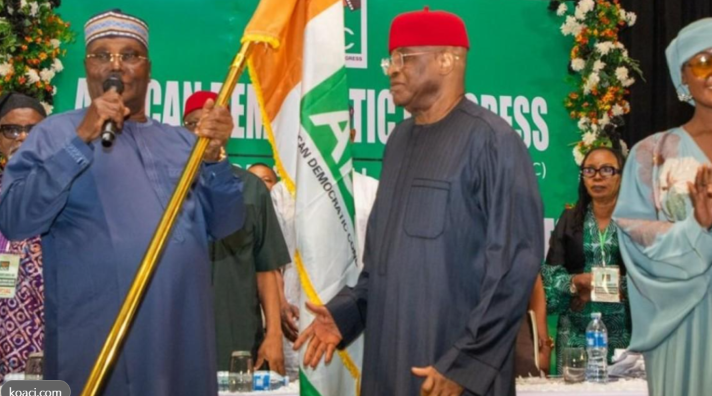
A Federal High Court in Abuja has nullified the leadership of the African Democratic Congress (ADC) led by former Senate President David Mark and invalidated the process that produced former Vice-President Atiku Abubakar as the party’s presidential candidate for the 2027 general election.
The judgment, delivered on Thursday, November 5, by Justice Peter Lifu, also affected the emergence of former Minister of Interior, Rauf Aregbesola, as the party’s National Secretary, alongside other national officers.
The court further nullified decisions taken by the Mark-led leadership, including the nomination of candidates for elective positions ahead of the 2027 elections.
The case was instituted by Nafiu Bala Gombe, a former Deputy National Chairman of the ADC, who challenged the process through which Mark and other members of the caretaker committee assumed control of the party.
Gombe argued that following the resignation of former National Chairman Ralph Nwosu, he was constitutionally entitled to take over the party’s leadership.
He subsequently approached the court, asking it to invalidate the actions of the Mark-led leadership and prevent Mark and Aregbesola from presenting themselves as the party’s National Chairman and National Secretary.
Delivering judgment, Justice Lifu held that the emergence of the Mark-led leadership violated the ADC constitution, relevant provisions of the Electoral Act and the 1999 Constitution.
The court also directed the Independent National Electoral Commission (INEC) not to recognise or act on decisions taken at the party’s 99th National Executive Committee meeting held on July 27, 2025.
The ruling has created significant uncertainty for the ADC because the party had already conducted its presidential primary and presented candidates for several elective positions.
Atiku had emerged as the party’s presidential candidate in May 2026, while former Rivers State Governor Rotimi Amaechi was selected as his running mate.
The judgment therefore raises questions about the legal standing of the party’s nominations and its ability to participate fully in the forthcoming elections.
Reacting to the decision, Atiku rejected the judgment and accused the ruling All Progressives Congress (APC) of attempting to weaken the opposition ahead of the general election.
He insisted that the ruling would not stop his presidential ambition, promising to continue his campaign.
The ADC also rejected the judgment, describing it as an attempt to undermine democratic competition. The party announced its intention to challenge the decision through the available judicial processes.
Meanwhile, Nafiu Bala Gombe welcomed the judgment, insisting that the decision had affirmed his position as the party’s legitimate national chairman.
The development has attracted attention from political stakeholders because the ADC has been positioning itself as one of the major opposition platforms ahead of the 2027 presidential election.
The legal dispute is now expected to move to the appellate courts, where the parties will seek further clarification on the leadership and nomination questions.
Until the matter is finally resolved, the ruling is likely to remain a major issue in Nigeria’s political landscape.