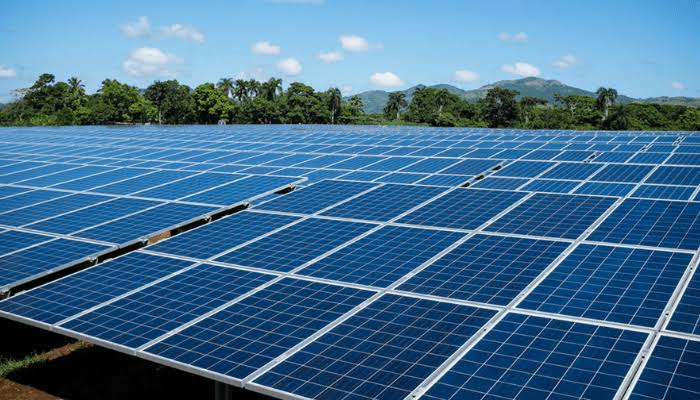
Solar power has, for the first time, become cheaper than electricity supplied from Nigeria’s national grid, marking a significant turning point in the country’s quest to provide reliable energy to its over 200 million citizens amid persistent failures in the traditional power infrastructure.
Electricity tariffs from the national grid have risen sharply to between N220 and N270 per kilowatt-hour, more than double previous consumer rates, according to data from Financial Derivatives Company Ltd. In contrast, solar and wind installations are now producing electricity at between N85 and N140 per kilowatt-hour, making renewable energy not only more affordable but also more dependable than gas-fired generation.
The cost gap widens further when operational expenses are considered. Annual fuel costs for gas-fired power plants have climbed to between N120 billion and N150 billion, while a 100-megawatt solar installation incurs just N1.7 billion to N2.5 billion in operation and maintenance costs, the analysis shows.
“Back then, when you looked at the cost of grid power and diesel, solar was still more expensive,” said Adewale Odugbesan, Chief Executive Officer of Royal Power & Energy Limited. “But if I’m comparing A and B now, the cost of solar is now cheaper.”
The price reversal comes as Nigeria continues to grapple with chronic power shortages that have constrained economic growth and forced businesses and households to rely heavily on costly diesel generators.
“We’ve displaced tens of thousands of diesel generators,” said William Brent, Chief Marketing Officer at Husk Power Systems, which has deployed about 400 solar-and-battery mini-grids across Nigeria and India. According to him, these systems now power pharmacies, shops and small businesses at roughly half the cost of grid electricity.
Industry analysts note that the rapid decline in renewable energy costs has been driven largely by global trends, particularly China’s massive production of solar panels and batteries, which has significantly reduced hardware prices worldwide.
“It has become very difficult to make any other choice in some places,” said Heymi Bahar, a senior analyst at the International Energy Agency (IEA).
In 2010, the IEA projected that global installed solar capacity would reach 410 gigawatts by 2035. That figure has already been exceeded more than four times over, with about half of the capacity located in China.
Across Africa, the Middle East and even oil-rich countries such as Saudi Arabia, solar power deployment is accelerating. “It’s a very cheap way to harness the sun,” said Kingsmill Bond, an energy strategist at think-tank Ember.
With zero fuel costs and minimal maintenance requirements, solar power offers predictable and inflation-resistant pricing—an important advantage in an economy where the naira has lost significant value against the dollar.
The development is accelerating Nigeria’s shift toward decentralised renewable energy solutions, particularly solar-powered mini-grids that bypass the country’s fragile transmission network.
About 170 existing mini-grid networks, most of them solar-powered with battery storage, are already delivering more reliable electricity than the national grid. These systems combine solar panels, battery storage, local distribution lines and smart prepaid meters to provide consistent power regardless of grid availability.
Twenty-eight additional mini-grids are scheduled for completion in the first quarter of 2026, underscoring growing government confidence in distributed power generation as grid supply continues to deteriorate in both rural and urban areas.
“Mini-grid is the key technology option because we continue to witness the real-life impact of the technology across sectors,” said Abba Aliyu, Chief Executive Officer of the Rural Electrification Agency.
“This solution is not only an electrification tool but a development catalyst, powering communities, schools, health centres, security, markets and accelerating inclusive economic growth,” he added.
For households and businesses alike, the shift has made solar energy increasingly accessible across a wide range of price points, signalling a structural change in how Nigerians generate and consume electricity.