The Managing Director of the Dangote Petroleum Refinery, Mr David Bird, has clarified that the $20bn Lekki-based facility is not importing finished petroleum products, explaining that the refinery operates a merchant refining model that allows it to source crude and intermediate feedstocks from the global market.
Bird made the clarification on Wednesday while addressing journalists at the Dangote Refinery in Lekki, Lagos, following concerns in some quarters that the facility was importing fuel into the country.
According to him, what some individuals had described as imported fuel were, in fact, intermediate feedstocks used in further processing. He stressed that the refinery was deliberately designed to operate differently from conventional refineries in crude-producing countries.
“Nigeria is a crude-producing country, but Dangote Refinery does not sit on the end of a pipeline just processing the country’s crude oil only. Dangote is a merchant refinery,” Bird said during a technical presentation on the plant’s operations.
He explained that unlike refineries in countries such as Saudi Arabia, Kuwait, and the United Arab Emirates, which are typically located at the end of crude oil pipelines and depend largely on domestic crude supply, the Dangote Refinery sources a wide range of crudes and feedstocks delivered mainly by sea.
According to Bird, merchant refineries are common in major global refining hubs such as Europe, Singapore, and Taiwan, and the same model was intentionally replicated in Nigeria to maximise value and ensure operational flexibility.
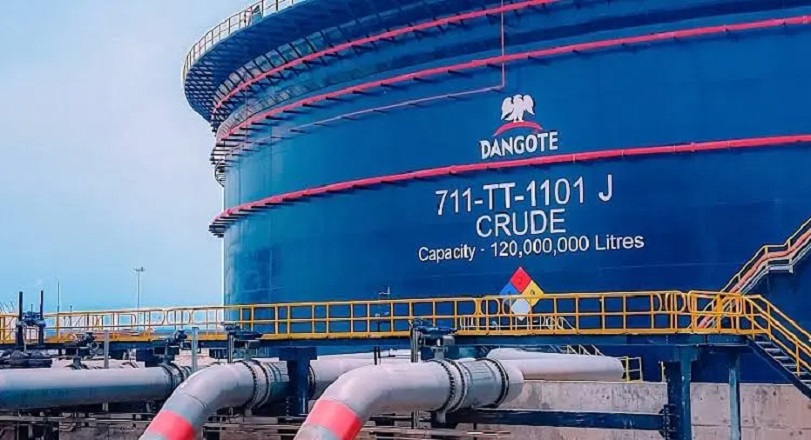
He further explained that this structure accounts for the refinery’s large tank farm, which he described as significantly bigger than the processing units. Storage capacity, he said, is central to merchant refining as it allows different crudes and feedstocks to be segregated, blended, and processed in varying combinations.
“You bring in different crudes. You need to segregate those crudes, and then you mix them to make certain crude cocktails which your plant can process,” he said.
Bird noted that different crudes yield varying proportions of products such as liquefied petroleum gas (LPG), naphtha, kerosene, and diesel. As a result, processing only one crude stream could lead to underutilisation of certain units if additional feedstocks are not introduced.
Because refining is highly capital-intensive, he said maximising utilisation across all units is critical to profitability. “It’s all about utilisation. Just like an aeroplane or a hotel, once you build it, you want to drive occupancy. The same principle applies to refining,” he explained.
The refinery boss said the real value in refining lies not in crude distillation alone, which simply separates products, but in advanced conversion units that upgrade low-value materials into high-value products.
He disclosed that the Dangote Refinery converts heavy residues from crude distillation into high-value white products using sophisticated units such as the Residue Fluidised Catalytic Cracker. Where certain crudes yield low volumes of residue, the refinery imports residue feedstocks to keep these conversion units fully utilised.
“This is a real moneymaker for us. We crack low-value residue and convert it into high-value white product,” Bird said.
He added that the refinery is also designed to accept a wide range of intermediate feedstocks, including cracked distillates, reformate, light cycle oil, heavy diesel, and LPG, which are further processed into finished fuels that meet global specifications.
Addressing import concerns directly, Bird said the refinery has no interest in importing finished petroleum products for sale. “I am a refinery. I have no interest in importing finished products. But I will be importing intermediate feedstocks and components,” he stated.
He explained that some imported components, such as high-sulphur reformate, are exported by other refineries that lack the capacity to process them further. According to him, Dangote Refinery has the capability to upgrade such materials into Euro 5 specification gasoline.
“This should never end up in a petrol pump,” he said, adding that some locally produced Nigerian condensates, despite their clear appearance, have low octane ratings and are unsuitable for direct vehicle use without further processing.
“They look good, but they are about 75 octane. You wouldn’t want this in your car,” Bird said.
He noted that the refinery’s blending and processing systems enable these various intermediate streams to be upgraded into high-quality finished fuels that meet the latest international standards.
Bird said the refinery is currently producing petrol with 50 parts per million sulphur content and is technically ready to move to 10 ppm once Nigeria upgrades its fuel specifications.
He added that the quality of products from the refinery has already been proven in international markets, with gasoline exported to the United States and aviation fuel supplied to global destinations.
“If we couldn’t make this product to the right specification, we wouldn’t be able to export it,” he said, stressing that the facility produces fuels that meet the most recent global standards.
Bird said Nigeria should take pride in the refinery’s capability to produce cleaner fuels, noting that higher fuel standards also translate into significant public health benefits.
“Nigeria should be incredibly proud because of the public health benefits that come from having a domestic refining industry that produces fuels to the latest world standards,” he added.