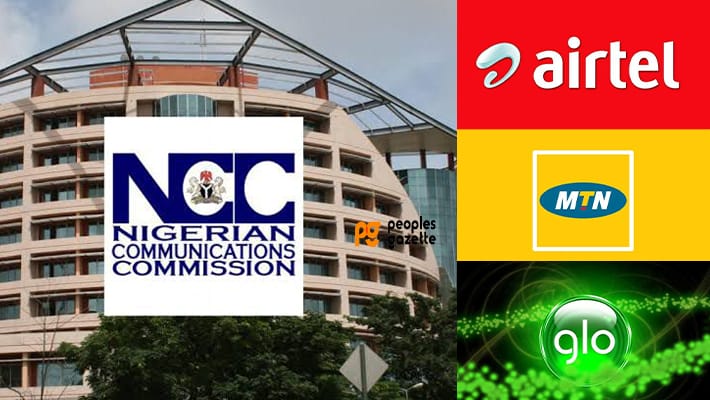
The Nigerian Communications Commission (NCC) has directed telecommunications operators in Nigeria to compensate subscribers with airtime credits whenever service disruptions occur, under a new consumer protection framework aimed at improving service quality across the industry.
The regulator said compensation will be issued automatically to affected users in areas experiencing network failures, marking a shift toward stricter enforcement of quality-of-service standards in the country’s telecommunications sector.
In a statement issued on Sunday, Head of Public Affairs at the commission, Nnenna Ukoha, explained that affected subscribers will receive airtime credits calculated based on their average spending patterns and their presence within the local government areas where service failures occur.
“Subscribers should not be made to bear the full burden of service disruptions where operators fail to meet prescribed standards of service delivery,” she said.
The commission noted that the directive aligns with its broader consumer-focused regulatory philosophy, which prioritises the interests of subscribers within Nigeria’s telecommunications ecosystem.
According to the Nigerian Communications Commission, telecommunications services have become critical to economic activities, social interaction, and access to digital opportunities.
“Telecommunications services today underpin economic activity, social interaction, and access to digital opportunities. When service quality is poor, the consequences affect productivity, commercial activities, and even public confidence in our communications system,” the regulator stated.
Beyond compensating subscribers, the commission also issued new directives to tower companies responsible for telecommunications infrastructure such as masts and base stations.
The regulator said these firms must reinvest fines imposed on them into measurable infrastructure improvements to enhance network performance and reliability.
“The commission will continue to reinforce the obligation of operators to invest consistently in network resilience, capacity expansion, and infrastructure upgrades to meet the growing demand for telecommunications services,” it added.
The commission further noted that it will continue to deploy regulatory tools designed to promote fairness, transparency, and accountability within the sector.
“Further to this directive, the commission is also mandating tower companies to invest in infrastructure with measurable outcomes using sums that it has fined these companies, in addition to other financial fines the commission will deem appropriate,” the statement said.
The new directive comes amid a sharp increase in telecommunications network outages across the country in 2026, according to data tracked through the commission’s Uptime Portal.
Industry data showed that Nigeria recorded 238 network outages, representing a 101.7 per cent increase compared to December 2025. Fibre cuts accounted for the majority of disruptions, responsible for 67.6 per cent or 161 incidents, while power outages caused 18.5 per cent, representing 44 cases.
Major operators such as MTN Nigeria and Airtel Nigeria, alongside other providers including T2Mobile and internet service providers such as BCN, experienced widespread service challenges affecting multiple states.
The disruptions impacted several parts of the country including Abia State, Cross River State, Enugu State, and Lagos State, with some repair operations taking up to six days to restore services.
Data further showed that fibre cuts surged by 900 per cent in January, rising to 40 incidents and continuing into February with 18 additional cases recorded by mid-month, bringing the total to 58 fibre-related disruptions in early 2026.
More than 90 per cent of these incidents occurred in Abuja, with additional cases reported in Lagos State, Enugu State, Benue State, Anambra State, and Abia State.