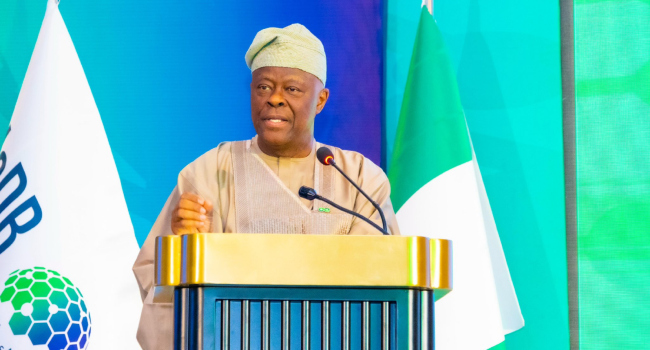
The Federal Government of Nigeria has reinforced its shift toward investment-led economic growth, signalling a transition from stabilisation measures to a stronger focus on private capital mobilisation, productivity, and job creation.
This was disclosed by the Minister of Finance and Coordinating Minister of the Economy, Wale Edun, while speaking at the Islamic Development Bank Group Day held in Lagos.
Edun explained that the country’s partnership with the Islamic Development Bank has already delivered over $2.2 billion in investments across strategic sectors. These include energy, infrastructure, agriculture, and digital development—areas considered critical for boosting competitiveness and sustaining long-term economic growth.
According to the minister, the next phase of reforms under Bola Ahmed Tinubu will be driven by large-scale private sector investments aimed at attracting capital, expanding economic opportunities, and creating jobs.
“Clearly, we are moving from the stabilisation of the economy to a trajectory of growth, acceleration, and investment mobilisation,” Edun said.
He emphasised that productivity-enhancing investments remain central to the government’s macroeconomic agenda. Such investments, he said, will grow the economy, increase incomes, create employment, and reduce poverty.
“Our mission, as laid out by Mr President, is very clear: to build a $1 trillion economy powered by productive sectors, private capital, innovation, and technology,” he said. “To achieve this, we are prioritising a fundamental shift from reliance on public financing to mobilising private sector investment at scale.”
Edun added that Nigeria is focusing on expanding projects in technology, climate action, and agriculture to meet the demands of a large population and growing workforce. He noted that the government is working to strengthen domestic production and refining capacity while ensuring sustainable growth.
The minister also explained that the new cooperation framework with the Islamic Development Bank will span 2026 to 2028, supporting infrastructure development, agribusiness industrialisation, and broader economic inclusion.
Through the partnership, the government aims to bring 10 million Nigerians into productive economic activity, modernise infrastructure, and stimulate job-rich sectors of the economy.
Edun stressed that the country must prioritise large-scale employment opportunities, noting that Nigeria produces about 600,000 graduates annually who require meaningful job prospects.
He also highlighted the importance of resilience in the face of global economic and political uncertainties, stating that Nigeria must strengthen institutions, deepen international partnerships, and implement sound economic policies.
According to the minister, government spending alone cannot meet the country’s development needs, as the public sector represents only about 10 per cent of the economy, while the private sector accounts for roughly 90 per cent.
Meanwhile, Anasse Aissami, Director-General for Country Programs at the Islamic Development Bank, said the institution is deepening its partnership with Nigeria to support economic diversification, job creation, and improved livelihoods.
He noted that the renewed collaboration reflects a broader strategy to mobilise investment at scale and convert international partnerships into tangible economic outcomes.