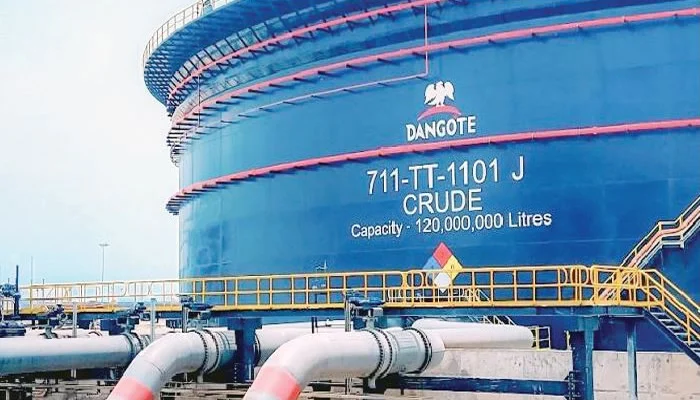
The Dangote Petroleum Refinery has again increased the gantry prices of petrol and diesel, tightening pressure on consumers and businesses across Nigeria.
A senior official at the refinery confirmed the development on Tuesday night, explaining that the adjustment was necessary due to rising international crude oil benchmarks and prevailing global market conditions.
According to the new pricing structure, the gantry price of petrol has increased by N75 per litre to N1,275, representing about a 5.02 per cent rise. Diesel recorded a larger jump of N200 per litre, pushing its price to N1,950 per litre.
The latest adjustment marks a notable increase from last month’s prices, when petrol sold for N1,200 per litre and diesel for N1,750 per litre at the gantry. With the new increase, diesel prices are now approaching the N2,000 per litre threshold, raising concerns about the potential impact on transportation and production costs nationwide.
The refinery official noted that the price review reflects developments in the global oil market.
“The adjustment is in line with global market trends. You are aware of the ongoing tensions in the Middle East and how they have impacted crude oil prices. These are external factors that directly influence refined product pricing,” the official said.
He further explained that petrol was revised upward by about five per cent, while diesel recorded a sharper increase due to stronger price pressures in the international market.
Market data from Petroleumprice.ng also confirmed the change, showing that the new petrol price represents a 5.02 per cent increase at the gantry level.
The development comes at a time when many stakeholders expected increased local refining capacity to help stabilise fuel prices in Nigeria. However, industry analysts say the country remains vulnerable to fluctuations in global oil prices.
Despite being a crude oil producer, Nigeria operates a deregulated downstream sector, where fuel prices are largely determined by market forces. As a result, domestic fuel prices continue to be influenced by international crude prices, exchange rates, logistics costs, and operational expenses.
Global oil markets have also remained volatile in recent weeks due to escalating tensions in the Middle East, a region responsible for a significant share of the world’s crude oil supply. Any threat to supply routes often leads to price spikes that ripple across global refined product markets.
The Dangote Petroleum Refinery, regarded as Africa’s largest refinery, was expected to reduce Nigeria’s reliance on imported fuel and contribute to price stability.
However, experts say domestic prices will likely continue to fluctuate as long as crude oil pricing remains tied to global benchmarks.
With the latest increase, marketers are expected to adjust pump prices across the country in the coming days. Such adjustments could further strain households and businesses already grappling with rising energy and transportation costs.
Economists warn that sustained fuel price increases could intensify inflationary pressures and slow Nigeria’s fragile economic recovery.