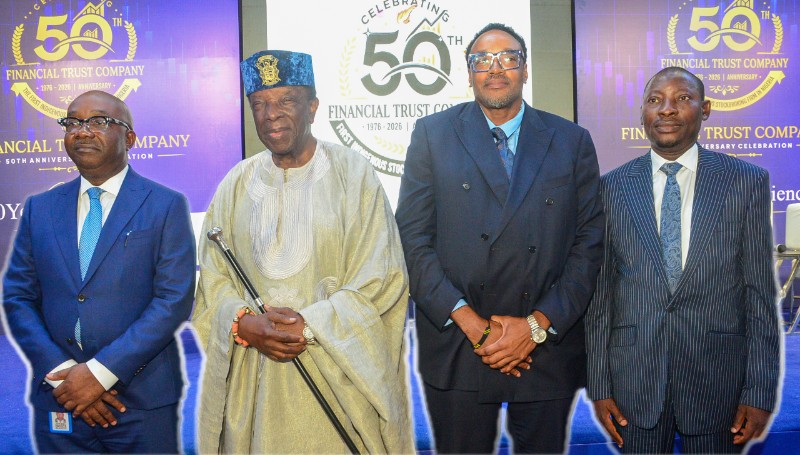
Stakeholders across Nigeria’s capital market ecosystem gathered in Lagos on Thursday to celebrate the 50th anniversary of Financial Trust Company (FTC), Nigeria’s first indigenous stockbroking institution.
The golden jubilee celebration attracted tributes from regulators, market operators, and industry leaders who praised the company’s founder, Olufemi Ajayi, for his pioneering vision in establishing the firm in 1976.
Speaking at the event, Director-General of the Securities and Exchange Commission, Emomotimi Agama, described the anniversary as more than a corporate milestone.
Represented by John Briggs, Agama said the occasion offered an opportunity to honour the pioneers who built enduring financial institutions despite operating in difficult economic and regulatory conditions.
According to him, Nigeria’s capital market evolved from humble beginnings marked by limited capital, weak investor confidence, and a developing regulatory framework.
“Our pioneers understood that markets are not just about transactions; they are about trust, institutions, and confidence in the future. Their legacy deserves our respect, and their example should continue to inspire the next generation,” Agama stated.
Also speaking, Chief Executive Officer of Nigerian Exchange Limited, Jude Chiemeka, represented by Abimbola Babalola, said the history of FTC is closely connected to the development of Nigeria’s capital market.
“Fifty years is not merely a corporate milestone but a testament to resilience, relevance, institutional character, and sustained contribution to national economic development,” he said.
Chiemeka added that stronger collaboration across the capital market ecosystem would be essential as Nigeria seeks to strengthen its position as a leading African investment destination.
President and Chairman of Council of the Chartered Institute of Stockbrokers, Fiona Ahimie, also described the anniversary as a celebration of resilience, professionalism, innovation, and lasting impact.
According to her, FTC’s journey symbolises the triumph of indigenous enterprise at a time when confidence in local capacity was limited.
“Today, we celebrate not only an institution but also a legacy of excellence that has contributed significantly to the growth and development of the Nigerian capital market,” she said.
Ahimie noted that FTC played a strategic role in transforming Nigeria’s capital market from a relatively modest structure in the 1970s into a more sophisticated financial ecosystem.
Chairman of the Association of Securities Dealing Houses of Nigeria, Sehinde Adenagbe, commended FTC for navigating decades of regulatory reforms, economic cycles, and institutional transitions under both military and civilian governments.
“Through all these periods, the firm has remained resilient, compliant, and steadily progressive, continuing to strengthen its position in the capital market,” Adenagbe stated.
In his opening remarks, Group Managing Director and Chairman of FTC, Omoniyi Ajayi, attributed the company’s longevity to integrity, prudence, and institutional continuity.
“The company endured because it was built on the principle that integrity is more valuable than expansion, and continuity more valuable than ambition unmoored from prudence,” he said.
Ajayi explained that continuity remains the organisation’s greatest institutional asset, stressing that FTC has maintained strong leadership and institutional identity since its establishment in 1976.
He further disclosed that the company now holds one of the broadest licence portfolios among indigenous capital market firms in Nigeria, covering stockbroking, issuing house services, fund management, trusteeship, dealership operations on the FMDQ Securities Exchange, and investment banking services through its subsidiary, FT_Nex Rubica.
According to him, the firm has also pioneered asset classes tailored to the Nigerian market, developed offshore trading capabilities, and invested in technology platforms serving clients in Nigeria, London, and the diaspora.
“Our commitment for the next fifty years rests on four pillars: professionalism without compromise, technology and talent development, market advocacy, and knowledge transfer,” Ajayi said.
The event also featured goodwill messages from institutions including the Lagos Commodities and Futures Exchange, represented by Eyowan Ani, and the Pension Fund Operators Association of Nigeria.
The anniversary celebration concluded with renewed calls for stronger collaboration, innovation, institutional integrity, and sustained indigenous participation to deepen Nigeria’s capital market and position it competitively on the global stage.