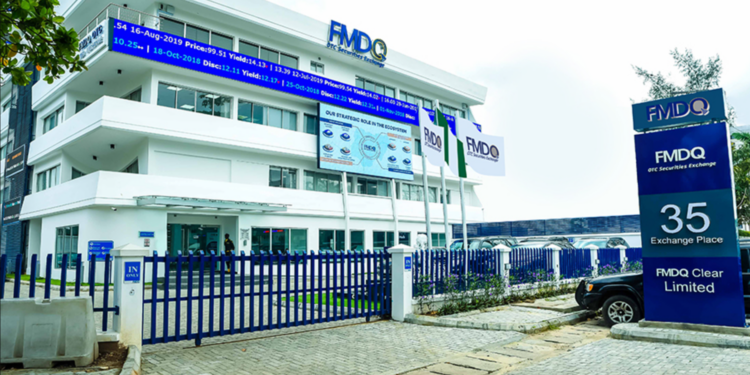
The FMDQ Exchange recorded a total market turnover of N249.18 trillion between January and April 2026, equivalent to approximately $180.85 billion, reflecting sustained trading activity across Nigeria’s fixed income and foreign exchange markets.
The figures were disclosed by the Group Chief Operating Officer of FMDQ Exchange, Tumi Sekoni, in the April edition of the Exchange’s Newsletter, Edition 138.
According to the report, the four-month turnover represents an increase of N55.98 trillion over the N193.20 trillion recorded in the first quarter of 2026, indicating that April alone contributed nearly N56 trillion in additional market activity.
The cumulative turnover was achieved over 77 business days, translating to an average daily turnover of N3.24 trillion, or about $2.35 billion. This was slightly below the N3.27 trillion average daily turnover recorded during the first quarter.
A breakdown of the trading figures showed a major shift in market leadership, with Open Market Operation Bills emerging as the largest contributor to turnover, overtaking foreign exchange transactions.
OMO Bills recorded N80.42 trillion in turnover, accounting for 32.3 per cent of total market activity, compared to N59.45 trillion and a 30.8 per cent share recorded at the end of the first quarter.
The development reflects the intensified use of open market operations by the Central Bank of Nigeria as a liquidity management tool amid tighter monetary conditions.
Foreign exchange transactions followed closely with N78.19 trillion, representing 31.4 per cent of total turnover. Although FX volumes increased from the N63.49 trillion recorded in Q1, its overall market share declined as OMO Bills activity accelerated.
Combined, OMO Bills and FX transactions accounted for approximately 63.7 per cent of total turnover during the four-month period, highlighting their continued dominance within Nigeria’s financial markets.
Repurchase Agreements and Open Repos ranked third with N36.70 trillion, contributing 14.7 per cent of total turnover, while Treasury Bills and Federal Government Bonds added a combined N42.72 trillion.
FX Derivatives accounted for N9.61 trillion, while Unsecured Placements and Takings contributed N1 trillion. Eurobonds and Sukuk Bonds jointly recorded turnover of about N522.21 billion, reflecting relatively lower participation in long-term instruments.
Analysts say the sharp increase in OMO Bills turnover signals the CBN’s continued commitment to liquidity tightening and short-term rate management through aggressive open market operations.
The steady level of repo market activity across the review period also suggests that financial institutions maintained elevated short-term funding requirements, a trend commonly associated with tighter interbank liquidity conditions.
The report further revealed that the implied exchange rate derived from the aggregate naira and dollar turnover figures stood at approximately N1,378 per dollar, providing a benchmark for prevailing FX market conditions during the period.
Several instruments, including CBN Special Bills, Promissory Notes, Commercial Papers, and Money Market Derivatives, recorded zero turnover during the four-month period, highlighting limited market participation outside core trading instruments.
The January-to-April performance builds on a strong 2025 full-year outing in which the FMDQ Exchange recorded total turnover of N676.71 trillion.
At the current pace, analysts believe the market could surpass its 2025 turnover record if momentum is sustained throughout the remainder of 2026.