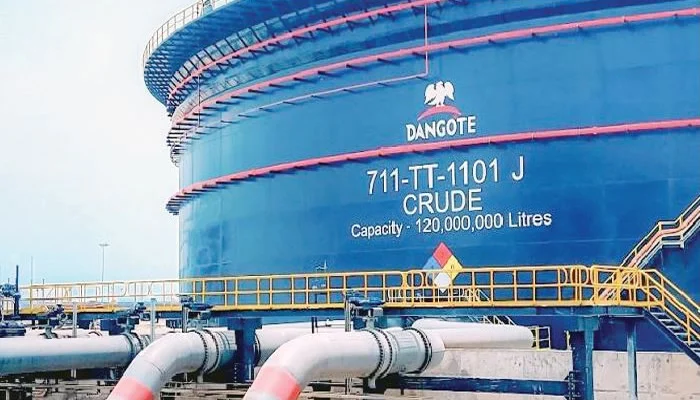
The Centre for the Promotion of Private Enterprise has dismissed claims that the Dangote Refinery poses a monopolistic threat to Nigeria’s downstream petroleum sector.
The economic advocacy group insisted that Nigeria should focus on supporting domestic refining investments instead of encouraging increased fuel importation.
In a policy statement released on Sunday, the CPPE argued that decades of dependence on imported petroleum products created major structural distortions within the Nigerian economy.
The statement, signed by the organisation’s Chief Executive Officer, Muda Yusuf, said fuel import dependence weakened the naira, intensified foreign exchange pressures and worsened fiscal imbalances under the fuel subsidy regime.
According to the group, Nigeria must prioritise the protection and expansion of local refining capacity rather than expose domestic investors to excessive import competition and regulatory uncertainty.
The CPPE stated that the era of heavy reliance on imported fuel imposed severe economic and fiscal costs on the country while exporting jobs and industrial value abroad.
The organisation described attempts to portray the Dangote Refinery as a monopolistic threat as simplistic, flawed and unfair.
It argued that the refinery did not stop other investors from entering the sector or cause the collapse of state-owned refineries.
According to the group, the refinery simply undertook an industrial investment on a scale never before seen in Africa.
The CPPE noted that for decades Nigeria’s dependence on imported petroleum products placed huge pressure on foreign reserves and weakened the local currency.
The organisation added that the system accelerated the collapse of domestic refineries, encouraged rent-seeking practices, worsened foreign exchange illiquidity and fuelled corruption within the subsidy regime.
It also stated that fuel subsidy payments consumed trillions of naira annually, while petroleum imports exceeded $10bn yearly during peak periods.
The CPPE warned that unrestricted importation of refined petroleum products could discourage future industrial investments in Nigeria.
According to the group, genuine competition in the downstream sector should come through the establishment of more domestic refineries instead of continued dependence on imports.
The organisation stressed that strategic sectors across the world often benefit from fiscal protections and supportive industrial policies.
It added that large-scale industrial investments naturally become more competitive through lower production costs, stronger value chains and improved economic resilience.
Nigeria has historically depended heavily on imported refined petroleum products despite being one of Africa’s largest crude oil producers.
The collapse and poor performance of state-owned refineries increased the country’s reliance on imported fuel for several years.
Fuel subsidy payments also placed significant pressure on government finances and foreign exchange reserves.
However, the commencement of operations at the Dangote Refinery and rising investments in modular refineries have started shifting the country toward domestic refining capacity.
The CPPE said the Dangote Refinery should be strategically supported and strengthened because of its significance to Nigeria’s industrial development.
In February, the refinery announced that it had reached its full designed refining capacity of 650,000 barrels of crude oil per day.
The company said the milestone followed the optimisation of its Crude Distillation Unit and Motor Spirit production block.
The refinery added that the achievement strengthened steady-state operations at Africa’s largest oil refining facility.
The emergence of large-scale refining capacity in Nigeria is also expected to change the long-standing perception of West Africa as a destination for substandard fuel products.
According to available figures, the refinery exported 456,000 tonnes of refined petroleum products through 12 cargoes lifted by international traders in March 2026.