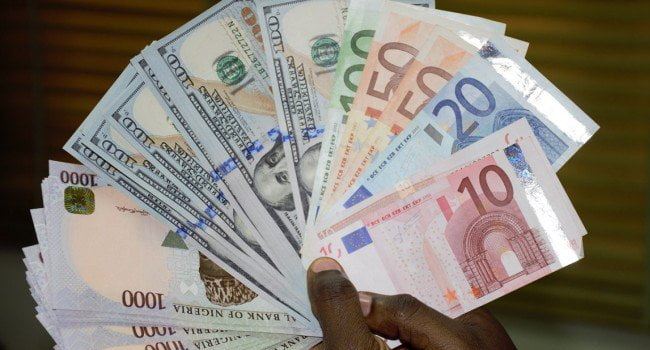
The Nigerian Naira recorded a slight appreciation against the Euro in the fourth trading session of the week, according to data released by the Central Bank of Nigeria (CBN).
The local currency closed at N1,573/€1, strengthening marginally from N1,574/€1 recorded in the previous session on Wednesday.
Market data showed that the EUR/NGN exchange rate has softened in recent sessions, reflecting increased demand dynamics and ongoing support for the naira from market interventions and policy measures.
The modest gain comes amid broader indications of improved currency stability in 2026, following sharp devaluations in previous years.
Analysts attribute the recent trend to a combination of stronger external reserves, tighter monetary policy, and improved FX liquidity management by the Central Bank of Nigeria.
Nigeria’s foreign reserves are estimated at around $50 billion, providing the CBN with greater capacity to intervene in the foreign exchange market when necessary.
The apex bank’s hawkish monetary stance, including sustained high interest rates, has also played a role in supporting the naira by attracting foreign portfolio inflows, although inflationary pressures continue to erode real returns.
In addition, Nigeria’s reserves have been periodically strengthened by crude oil earnings and external financing from institutions such as the World Bank and the African Development Bank (AfDB).
Despite recent gains, structural pressures remain, including persistent food and energy price shocks that continue to weigh on the currency’s long-term fundamentals.
Nigeria’s reliance on imports—particularly machinery, chemicals, and finished goods from Europe—also sustains demand for foreign currency, contributing to ongoing FX market pressures.
Traders are closely watching key technical levels, with psychological support around N1,550/€1 and resistance near N1,650/€1 in the official market window.
Meanwhile, global currency dynamics are also influencing the Euro, as markets react to monetary policy expectations from the European Central Bank (ECB).
The ECB is expected to take a data-driven approach to interest rate decisions, with speculation of further tightening in response to inflation risks driven by energy prices and geopolitical tensions.
Rising energy costs, partly linked to instability in the Middle East, have added volatility to global markets, with investors closely monitoring developments that could influence inflation and growth in the Eurozone.
Currency analysts say the EUR/USD pair remains highly sensitive to ECB policy signals, with traders pricing in potential rate adjustments depending on inflation trends and economic forecasts.
Geopolitical developments, including tensions involving Iran and shifting US policy signals, have also contributed to market uncertainty and safe-haven flows into the US dollar.
Overall, the naira’s modest gains reflect a mix of domestic policy support and shifting global conditions, though analysts caution that sustained stability will depend on continued FX inflows, inflation control, and broader macroeconomic reforms.