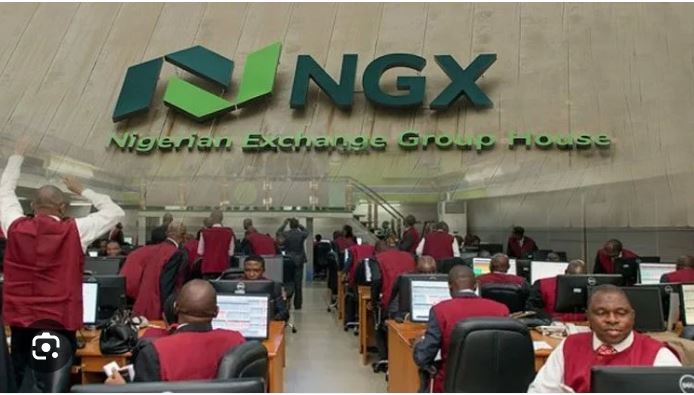
The Nigerian equities market is experiencing a mild cool-off after a strong first-half rally that pushed the market into record territory.
The Nigerian Exchange (NGX) recorded a more than 55% surge in the first six months of the year, with the All-Share Index surpassing historic highs and total market capitalisation crossing ₦160 trillion before the recent pullback.
Market data shows that the All-Share Index has now retraced by about 4% from its peak, stabilising around the 240,800-point level. Analysts describe the movement as a normal consolidation phase rather than a structural downturn.
“There’s a market retracement, not a structural breakdown,” market watchers noted, pointing to sustained investor interest in fundamentally strong stocks.
Despite the pullback, corporate fundamentals across the market remain broadly solid, supported by macroeconomic stabilisation policies and improving earnings visibility.
Stocks in the agricultural and export-linked segment, including Presco Plc and Okomu Oil Palm Plc, have continued to deliver strong long-term gains. Their resilience is largely attributed to foreign currency exposure, which provides a natural hedge against naira volatility.
Large-cap stocks such as Dangote Cement Plc, BUA Foods Plc, and MTN Nigeria Communications Plc are currently trading in a consolidation phase after earlier gains.
The banking sector has faced renewed selling pressure, while select energy and industrial names, including power sector players, have seen profit-taking following strong year-to-date performance.
Despite the recent volatility, the NGX remains attractively valued, with a price-to-earnings ratio estimated at 6.92x—well below its 10-year average of 11.3x and significantly cheaper than comparable regional markets such as South Africa and broader frontier indices.
Analysts say this valuation gap continues to attract long-term institutional interest, particularly from pension fund administrators and domestic asset managers seeking exposure to equities amid high fixed-income yields.
The Central Bank of Nigeria’s efforts to stabilise foreign exchange liquidity have also improved market predictability, helping to reduce volatility that previously weighed on corporate earnings.
Sectoral performance remains mixed. Oil and industrial stocks are benefiting from improved operational efficiency and revenue growth, while the banking sector continues to report strong profits driven by elevated interest rates, even as recapitalisation and holding company reforms create short-term uncertainty.
Consumer goods stocks, however, remain under pressure due to weak purchasing power despite easing inflation trends.
From a technical standpoint, the market faces resistance between 245,000 and 247,500 points, where repeated attempts to break higher have triggered profit-taking.
A decisive breakout above 247,500 with strong volume could signal continuation of the bullish trend, while a move above 254,000 points would indicate a fresh phase of price discovery.
On the downside, immediate support is seen around 240,000 points, a level viewed as critical for short-term sentiment. A deeper support zone lies between 214,000 and 220,000 points, which previously attracted strong institutional buying.
However, analysts maintain that the broader bullish structure remains intact as long as the index stays above 220,000 points, with long-term earnings growth expected to support valuations.