Global stock markets ended mixed on Friday, while oil prices climbed after Switzerland confirmed the postponement of planned talks following the US-Iran agreement, halting a week-long rally in equities.
Markets had rallied strongly since last weekend’s announcement by the United States and Iran that they would end their three-month conflict and reopen the Strait of Hormuz, easing fears of energy shortages and surging inflation.
The agreement, signed separately by US President Donald Trump and Iranian President Masoud Pezeshkian and approved by Iran’s supreme leader, was expected to pave the way for 60 days of negotiations on broader issues, including Iran’s nuclear programme.
However, Swiss officials said the talks scheduled for Friday would not proceed as planned, following the cancellation of US Vice President JD Vance’s trip. A spokesperson said the “logistics of these negotiations have never been simple or predictable”.
The discussions, which were also expected to involve Qatar and Pakistan, have now been postponed with no new date announced. Switzerland said it remains ready to facilitate the talks, with preparatory work continuing at Burgenstock.
Iran’s Tasnim news agency reported that “nothing has been confirmed” regarding the delegation’s travel plans.
The delay triggered a reversal in global equity markets, with investors taking profits after several days of strong gains.
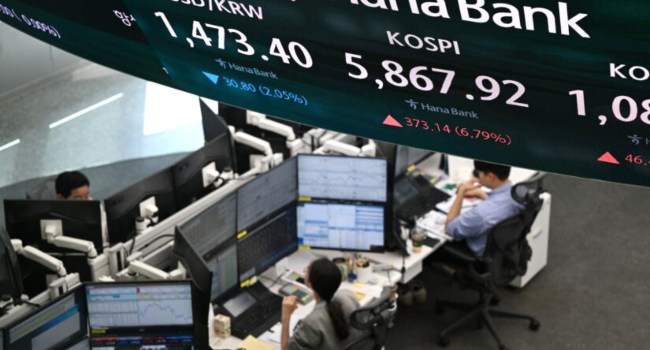
Asian markets saw widespread weakness, with Seoul—recently hitting record highs above 9,000 points—closing lower after an early rally led by technology stocks. Losses were also recorded in Tokyo, Singapore, Sydney, Mumbai, Bangkok and Jakarta, although Wellington and Manila edged higher.
In Europe, London dipped at the open, while Paris and Frankfurt posted gains. US markets remained slightly positive, with the Dow edging up 0.1 per cent.
Oil prices, which had fallen around 10 per cent earlier in the week, rebounded on renewed geopolitical uncertainty. West Texas Intermediate crude rose about 1.8 per cent to $78.01 per barrel, while Brent crude climbed 0.9 per cent to $80.53.
Analysts said the fragile nature of the US-Iran agreement continues to weigh on investor sentiment.
“With the deal signed, that geopolitical cloud is lifting, but markets have learned more than once that a resolution can unravel quickly,” said Josh Gilbert of eToro.
“The hard work starts now, and investors will likely be cautious until we’ve got an air-tight deal and traffic genuinely flowing in full through the strait again.”
The Strait of Hormuz, a critical global energy shipping route accounting for about one-fifth of global crude flows, has partially reopened, but analysts warned that supply normalization could take time.
US forces reportedly lifted a naval blockade of Iranian ports, though warships remain in the region to monitor developments.
Markets are also digesting signals from the US Federal Reserve, which recently indicated that interest rates could rise again before the end of the year due to inflationary pressures linked to the conflict.
Currency markets remained volatile, with the Japanese yen strengthening slightly but still trading near 161 per dollar—close to its weakest level since 1986—despite intervention measures by Japanese authorities.
Investors said the outlook remains uncertain, with markets likely to shift focus back to economic data and interest rate expectations in the coming weeks as geopolitical tensions continue to evolve.