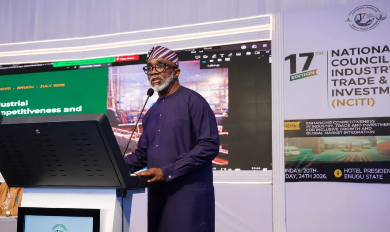
Nigerian manufacturers are paying between two and ten times more than their counterparts in Vietnam and China for electricity, credit and logistics, a cost burden that is weakening the country’s industrial base despite strong demand for locally produced goods.
The Executive Secretary of the National Sugar Development Council (NSDC), Kamar Bakrin, disclosed this while highlighting the major challenges facing Nigeria’s manufacturing sector.
According to Bakrin, the country’s manufacturing problem is not driven by weak demand but by the high cost of production.
“None of this is a demand problem. Nobody on this continent needs persuading to buy what Nigeria makes,” he said.
“It is a cost-of-production problem, and that distinction matters because costs, unlike demand, are within our power to fix.”
He noted that Nigerian manufacturers spent an estimated ₦1.34 trillion last year on self-generated electricity, describing the situation as unsustainable.
Bakrin said every factory in Nigeria has effectively become a private power producer because of unreliable electricity supply.
He added that manufacturers currently pay between 27 and 35 per cent for working capital, compared with about 9 per cent in Vietnam and 3 per cent in China.
The NSDC boss also pointed to logistics as another major challenge, noting that Nigeria ranks 88th out of 139 countries on the World Bank’s Logistics Performance Index, behind Vietnam, which ranks 43rd, and China, which ranks 19th.
He said the country’s manufacturing sector has remained stagnant, with its contribution to Gross Domestic Product (GDP) hovering around 8 per cent, while capacity utilisation has declined to 57.7 per cent.
Despite the challenges, Bakrin said recent improvements in the economy provide an opportunity for industrial growth.
He noted that inflation has fallen significantly from its peak, while Nigeria’s foreign reserves have risen to $51 billion, the highest level since 2009, giving manufacturers greater confidence to plan for the future.
He also said global manufacturers are relocating supply chains, warning that countries that fail to attract investments now may miss the opportunity for decades.
Bakrin stressed that the African Continental Free Trade Area (AfCFTA) has made competitiveness even more critical.
According to him, Nigeria must either become a major exporter within Africa or risk being overwhelmed by imports from other African countries.
He cited the fertiliser industry as evidence that targeted government policies can transform industrial production.
Bakrin explained that Nigeria’s urea production capacity increased from 500,000 tonnes in 2005 to 6.5 million tonnes after natural gas was priced as an industrial input rather than solely as a source of government revenue.
He said the policy helped position Nigeria among the world’s top 10 nitrogen fertiliser exporters.
To improve industrial competitiveness, Bakrin proposed four key targets by 2030.
These include ensuring 24-hour industrial power supply at 8 to 10 cents per kilowatt-hour, expanding access to single-digit interest loans, reducing port clearance time from the current 18 to 21 days to less than seven days, and doubling output per worker.
He also recommended the establishment of dedicated power arrangements in at least one industrial cluster in every state within the next 12 months.
Other proposals include harmonising federal and state levies, introducing a State Industrial Competitiveness Index to rank states on infrastructure and business conditions, and enforcing a “Nigeria First” procurement policy with quarterly compliance reports.
Bakrin stressed that every reform should have a clear implementation timeline, measurable targets and designated responsibility to ensure results.
He also urged state governments to leverage the Electricity Act 2023 to develop competitive electricity markets, simplify access to industrial land, streamline taxes and levies, and strengthen technical education to meet the needs of manufacturers.
According to him, these reforms would boost job creation, strengthen the naira through increased exports and import substitution, and help reduce the migration of skilled workers.