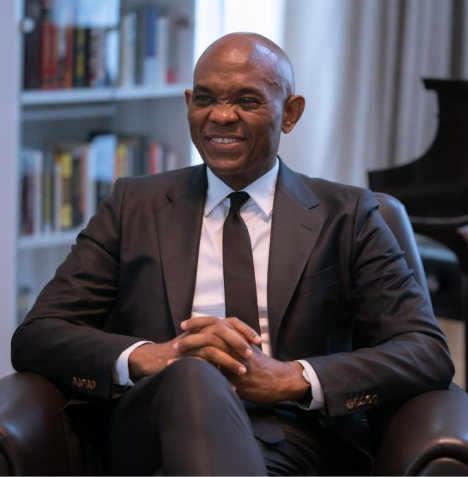
Group Chairman of Heirs Holdings and Transcorp, Tony Elumelu, has called on African banks and financial institutions to mobilise domestic savings and strengthen cross-border financing to unlock the continent’s economic potential.
Elumelu made the call while delivering the keynote address at the 25th annual conference of the Women in Management, Business and Public Service (WIMBIZ) in Lagos.
Speaking on the theme, The Geography of Opportunity: Why the World Needs What Africa Has, he argued that Africa must develop stronger financial institutions capable of supporting indigenous businesses, expanding regional trade and financing investments in critical sectors.
He maintained that the continent could achieve greater economic progress by investing its own resources rather than depending excessively on foreign aid and external financing.
According to him, African pension funds, insurance companies, banks and family offices must play a more active role in financing businesses across the continent.
He emphasised that the ability of Africa to transform its natural and human resources into sustainable prosperity would depend significantly on the development of local capital.
Elumelu argued that the continent must demonstrate that African savings can be used to establish and expand businesses capable of competing internationally.
The call comes at a time when many African economies continue to face financing difficulties despite possessing substantial natural resources and a growing population.
Businesses across the continent frequently struggle to access affordable long-term funding for expansion, infrastructure development and industrial production.
This challenge is particularly important for small and medium-sized enterprises, which account for a significant proportion of business activities and employment in many African countries.
Limited access to finance can prevent these businesses from investing in modern equipment, hiring additional workers and expanding into regional markets.
Elumelu believes that African financial institutions must become more active in addressing these challenges.
He explained that strong domestic financial institutions would help countries finance their development priorities while reducing dependence on external funding.
He also highlighted the importance of cross-border banking and financing.
According to him, African banks should support businesses seeking to expand beyond their domestic markets rather than limiting their activities to individual countries.
This is important because many African businesses operate in relatively small national markets and could benefit from access to customers and investment opportunities elsewhere on the continent.
The African Continental Free Trade Area (AfCFTA) provides an important framework for expanding regional commerce.
However, Elumelu argued that the agreement would struggle to achieve its full potential without adequate financial, physical and institutional infrastructure.
He pointed to the difficulties associated with transporting goods between African countries, noting that trade within the continent remains relatively limited.
In his address, he highlighted the importance of investing in roads, railways, ports, payment systems and efficient customs procedures.
Such investments could reduce the cost of moving goods across borders and make African businesses more competitive.
He also identified electricity supply as a major requirement for economic transformation.
Unreliable electricity increases operating costs for manufacturers and small businesses, forcing many companies to depend on expensive alternative power sources.
Improving electricity infrastructure would therefore support industrialisation, job creation and the development of competitive businesses.
Another issue raised by Elumelu was the need for Africa to increase local processing of its natural resources.
He argued that the continent should move beyond exporting unprocessed commodities such as lithium, cocoa and crude oil.
Developing local processing industries could help African countries capture more value from their natural resources and create additional employment opportunities.
For example, processing agricultural products locally could support food manufacturing, packaging and export activities.
Similarly, investing in mineral processing could strengthen industrial development and create opportunities for technology transfer.
Elumelu also highlighted the financing gap facing young African entrepreneurs.
He disclosed that 265,529 young Africans applied for his foundation’s entrepreneurship programme during the year, but only 3,200 received funding.
This represents approximately one funded applicant for every 83 applications.
The figures demonstrate the considerable demand for entrepreneurial support across the continent.
They also highlight the need for additional funding from banks, private investors, pension funds and other financial institutions.
Beyond financing, Elumelu stressed the importance of building an investment environment that encourages businesses to grow.
He identified contract enforcement, regulatory consistency, reliable electricity and functioning courts as important considerations for investors.
Investors are more likely to commit funds when they have confidence that agreements will be respected and business regulations will remain predictable.
The businessman also emphasised the importance of women’s participation in economic leadership.
He argued that excluding women from opportunities in banking, business and corporate management would weaken Africa’s competitiveness.
He cited the presence of women in leadership positions across UBA and Heirs Holdings businesses as examples of the value of inclusive leadership.
His message reinforces the need for African economies to combine domestic financing, regional trade, infrastructure investment and inclusive business development.
For Nigeria, the call is particularly relevant because stronger domestic financial institutions could help businesses access funding and participate more actively in regional trade.
Ultimately, Elumelu’s position is that Africa must take greater responsibility for financing its own economic transformation.
Mobilising local capital and strengthening cross-border banking could help create businesses capable of competing internationally while supporting sustainable development across the continent.