The World Bank and the Federal Government have intensified efforts to strengthen the implementation of the $500 million Human Capital Opportunities for Prosperity and Equity-Governance (HOPE-GOV) programme, with a focus on improving public financial management and service delivery in primary healthcare and basic education across Nigeria.
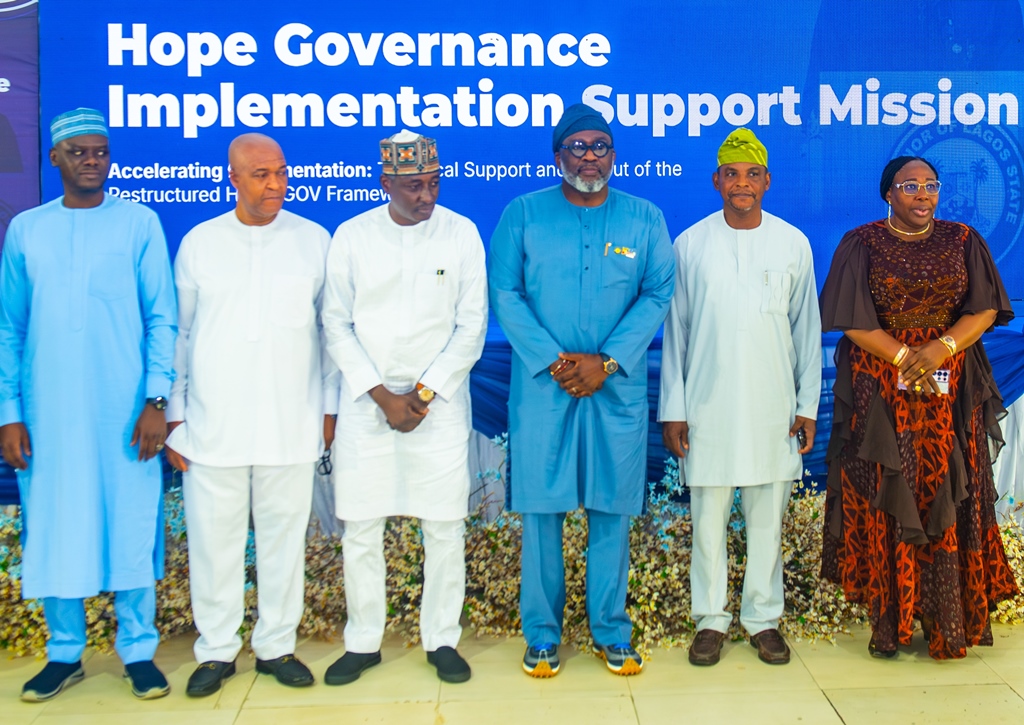
The renewed push formed the focus of a two-day regional Implementation Support Mission for the Southwest, hosted by the Lagos State Government in Ikeja, where government officials, development partners and representatives of participating states reviewed implementation challenges and strategies for improving programme outcomes.
National Coordinator of the HOPE-GOV programme, Dr. Assad Hassan, said the initiative was designed to strengthen the financial and human resource management systems underpinning the delivery of essential public services.
According to him, the programme, domiciled in the Federal Ministry of Budget and Economic Planning, represents a $500 million investment covering all 36 states and the Federal Capital Territory.
He explained that while the related HOPE Primary Healthcare and HOPE Basic Education programmes focus directly on improving service delivery, HOPE-GOV addresses the institutional and financial systems required to make those interventions effective.
The programme is particularly focused on improving budget planning, execution, accountability and the deployment of public resources in the two critical sectors.
Hassan disclosed that 388 officials drawn from the states and the Federal Capital Territory had recently undergone training on budget planning and execution for the 2027 fiscal year.
He said the objective was to ensure that allocations made to primary healthcare and basic education were supported by realistic implementation plans, allowing funds to translate into measurable improvements in service delivery.
Lagos State Commissioner for Basic and Secondary Education, Jamiu Tolani Alli-Balogun, said the state was pursuing a broad education reform agenda aimed at improving access, teaching standards and learning outcomes for children across different social backgrounds.
He highlighted the growing role of technology in education management, noting that digital interventions were being deployed to monitor school attendance, classroom participation and students’ learning outcomes.
The commissioner identified teacher capacity development, equitable access to education, digital learning and improved learning resources as key pillars of the state’s strategy.
He said Lagos was strengthening teacher recruitment, professional development and motivation to improve classroom instruction, while its Project Zero initiative was designed to bring out-of-school children back into the education system.
The initiative provides vulnerable children with support, including learning materials, uniforms and textbooks, to facilitate their reintegration into formal education.
Alli-Balogun also highlighted the distribution of smart learning devices to senior secondary school students to improve academic performance and prepare them for external examinations, including those conducted by the West African Examinations Council.
In addition, the state is pursuing more equitable distribution of core textbooks, particularly in Mathematics, English and Science, across more than 1,028 primary schools and 275 junior secondary schools.
World Bank Senior Public Sector Specialist and HOPE-GOV Team Leader, Ikechukwu Nweje, said the programme was being implemented through a Programme-for-Results financing model, under which participating states use their own institutional systems to achieve agreed targets and receive support based on independently verified performance.
He acknowledged that implementation had encountered initial delays and performance challenges but expressed optimism about progress in subsequent verification exercises.
Nweje said the programme was designed to address structural weaknesses affecting frontline service delivery, including inadequate numbers of qualified teachers in schools and shortages of skilled birth attendants in primary healthcare facilities.
He stressed that improving infrastructure and funding alone would not deliver the desired outcomes without ensuring that schools and healthcare centres had the personnel required to provide essential services.
Lagos State Commissioner for Economic Planning and Budget, Ope George, said effective implementation would depend on credible budgeting, institutional efficiency, payroll integrity and the deployment of resources based on evidence and actual service needs.
He described the regional restructuring mission as an important opportunity to assess implementation arrangements against operational realities and protect investments in the two sectors.
The Permanent Secretary of the Lagos State Ministry of Economic Planning and Budget, Olayinka Ojo, said Southwest states remained committed to providing the coordination, institutional leadership and administrative ownership needed to make the programme a model for subnational development.
She commended the World Bank and the Federal Ministry of Budget and Economic Planning for their technical support and responsiveness to the operational needs of states.
Also speaking, Ekiti State’s HOPE-GOV focal person and Director of Multilateral Relations in the Ministry of Budget and Economic Planning, Lawrence Omoniyi, said the state had used the programme’s framework to strengthen human capital development at the grassroots.
He disclosed that Ekiti had employed approximately 1,700 health workers and 1,000 basic education teachers as part of efforts to improve the availability of frontline personnel.
The two-day mission, which began on November 10 and ended on November 11, 2026, brought together World Bank officials and representatives of Southwest states to examine implementation progress, identify bottlenecks and strengthen coordination.
The programme’s success will depend not only on the availability of financing but also on the ability of participating states to improve budget execution, recruit and deploy qualified personnel, and demonstrate measurable improvements in healthcare and education outcomes.