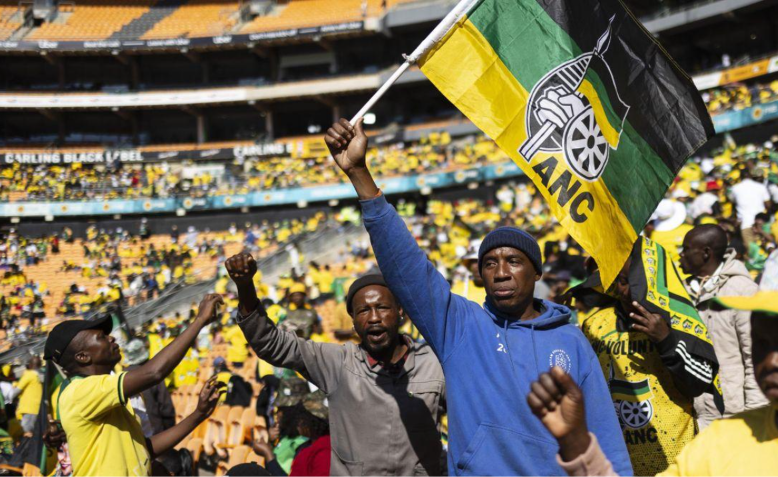
South Africa’s governing African National Congress (ANC) is facing renewed political pressure following a significant decline in its performance in the country’s 2026 municipal elections, with the results creating fresh challenges for the party as negotiations over local government control continue.
The election results showed that the ANC secured 30.76 per cent of the votes, while its main opposition party, the Democratic Alliance (DA), obtained 24.64 per cent. The uMkhonto weSizwe Party, associated with former President Jacob Zuma, came third with 9.76 per cent.
The outcome represents another difficult electoral moment for the ANC, which has experienced a gradual decline in voter support over recent years. The party previously dominated South African politics following the end of apartheid, but growing public dissatisfaction with service delivery and governance has affected its electoral performance.
According to the results released by the Independent Electoral Commission, the ANC secured 3,246 council seats across the country. The Democratic Alliance obtained 1,695 seats, while the uMkhonto weSizwe Party secured 785 seats.
The Economic Freedom Fighters received 6.22 per cent of the votes, while ActionSA secured 5.67 per cent. Other political parties and independent candidates shared the remaining votes.
The results have increased the importance of coalition negotiations in municipalities where no political party has secured enough seats to govern independently.
Coalition arrangements are particularly important in South Africa because municipal governments are responsible for delivering essential services, including water, electricity, sanitation, waste management and local infrastructure development.
The ANC’s electoral decline has been linked to public concerns about poor service delivery, unemployment, corruption allegations and the condition of public infrastructure. These issues have contributed to growing competition between political parties seeking to attract voters.
The Democratic Alliance and other opposition parties have continued to challenge the ANC’s record in government, arguing that municipalities require stronger accountability and improved administration.
However, the election outcome does not automatically mean that the ANC has lost control of every municipality. Official results indicate that the party achieved outright control in 53 municipalities and emerged as the leading party in 128 municipalities.
The Democratic Alliance secured outright control in 12 municipalities, while the Inkatha Freedom Party achieved outright control in five municipalities.
These figures demonstrate that although the ANC remains represented across the country, its reduced electoral strength means that negotiations with other parties will be important in several local councils.
Coalition governments can create opportunities for political cooperation, but disagreements over leadership positions, budgets and policy priorities can also affect their stability.
For South African residents, the immediate concern will be whether the newly formed municipal administrations can improve the delivery of basic services and address persistent economic challenges.
The ANC leadership will also face pressure to examine the reasons behind its declining support and determine how to rebuild public confidence before future elections.
The results highlight the changing nature of South African politics, where the country’s traditional political dominance is increasingly being challenged by a wider range of political parties.
As negotiations continue, the ability of political parties to establish stable local administrations will be important in determining how effectively municipalities respond to residents’ needs.