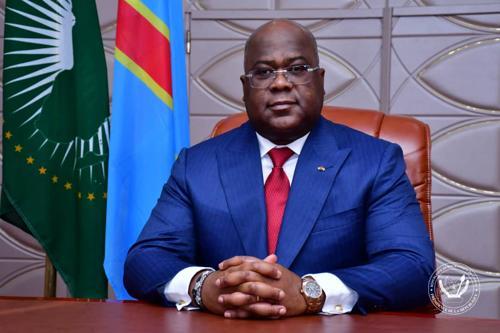
The Democratic Republic of Congo is facing renewed political controversy following President Félix Tshisekedi’s approval of a new law establishing procedures for constitutional referendums.
The legislation has attracted criticism from opposition figures and other political observers who fear that it could create an opportunity for constitutional changes affecting the country’s presidential term limits.
The law was signed by Tshisekedi on November 9, 2026, and its approval was announced on state television the following day.
According to reports, the legislation provides a framework for organising referendums on constitutional amendments and, under certain circumstances, the adoption of a new constitution.
The development has intensified an ongoing political debate over the future of the country’s constitutional arrangements and whether the current restrictions on presidential terms could eventually be reconsidered.
Tshisekedi, who became president in 2019, is serving his second term after winning re-election in 2023. Under the existing constitutional framework, presidents are limited to two five-year terms.
His current term is expected to end in 2028.
Opposition groups have expressed concern that the new legislation could be used to introduce constitutional changes that would allow Tshisekedi to remain in office beyond the existing two-term limit.
The concerns have emerged amid political disagreements over the president’s future and the direction of governance in the Central African country.
Tshisekedi has previously denied seeking a third term. However, he has also indicated that he would accept another term if the Congolese population wanted it.
The distinction between establishing a referendum procedure and actually changing the constitution is important.
The new legislation does not automatically remove the presidential term limit, nor does its approval mean that a referendum has already been scheduled.
Nevertheless, critics argue that the law raises questions about the protection of constitutional provisions that regulate presidential succession.
Under the existing constitution, important restrictions, including the limit on the number of presidential terms, are protected against ordinary parliamentary amendment.
This makes the debate particularly significant because any attempt to alter the country’s constitutional structure could generate further political disagreements.
The controversy is also unfolding against the background of insecurity in eastern Democratic Republic of Congo, where fighting involving armed groups has continued to affect communities and government control in parts of the region.
The security crisis has complicated political and administrative activities, with millions of people affected by displacement and instability.
Tshisekedi has previously suggested that elections scheduled for 2028 could face difficulties if the conflict in eastern Congo continues and certain territories remain outside government control.
This position has added another dimension to concerns about the country’s democratic institutions and electoral timetable.
For opposition parties, the priority is ensuring that constitutional procedures are not used to weaken democratic safeguards or extend political power beyond established limits.
The government, meanwhile, faces the challenge of explaining how the new legislation will operate and addressing concerns surrounding its possible implications.
The development is likely to remain an important issue in Congolese politics as the country approaches the end of Tshisekedi’s second presidential term.
The debate also reflects wider concerns across Africa about constitutional amendments, presidential succession and the protection of democratic institutions.