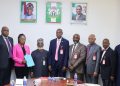
The Budget Office of the Federation (BoG) has dismissed claims circulating in the public space that the North East Development Commission (NEDC) operates a ₦246 billion budget solely for salaries, describing the allegation as false, misleading, and based on a poor understanding of the Federal Government’s budgeting system.
The Director General of the Budget Office, Dr. Tanimu Yakubu, made this known in a press release issued in Abuja on Thursday, stressing that the claims misrepresent how statutory allocations are presented in the national budget.
“This assertion is misleading, inaccurate, and rooted in a fundamental misunderstanding of the Federal Government of Nigeria’s budgeting framework,” Yakubu said.
He clarified that the ₦246.77 billion figure listed against the NEDC in the budget is not a salaries-only allocation, contrary to suggestions in some public discussions.
“Contrary to claims circulating in the public domain, the ₦246.77 billion reflected against the NEDC in the budget is not a salaries-only allocation,” he stated.
According to Yakubu, the figure represents a statutory lump-sum allocation presented at an early stage of the budgeting process, in line with standard practice under the Medium-Term Expenditure Framework for statutory and quasi-statutory agencies.
“It is a statutory lump-sum provision, initially presented at an aggregate level, consistent with established budget preparation practices for statutory and similar bodies,” he explained.
Yakubu added that claims suggesting about ₦244 billion of the amount is earmarked strictly for personnel costs are incorrect. He noted that during budget preparation, figures may temporarily appear under personnel costs when agencies have not yet submitted detailed internal expenditure breakdowns.
“This is a recognised procedural convention pending detailed submissions, legislative adjustments, and approved reallocations during budget execution,” he said, stressing that this technical presentation does not reflect actual spending plans.
Addressing concerns over capital expenditure, Yakubu explained that the ₦2.70 billion capital allocation cited in some reports resulted from adjustments made by the National Assembly in the 2025 budget, with about 70 per cent of the capital allocation shifted to the 2026 budget year as part of legislative timing decisions.
“This does not mean that development projects are missing or abandoned,” he said.
The Budget Office stated that detailed project schedules attached to the budget clearly outline ongoing and planned interventions across the North East, including agricultural support programmes, food security initiatives, rehabilitation of orphanages, rebuilding of internally displaced persons (IDP) camps, borehole projects, security support, and constituency-level interventions.
Yakubu warned that focusing on a single budget line without considering accompanying project schedules gives a distorted picture.
“Selective reading of a single budget line while ignoring accompanying schedules is not analysis—it is a distortion,” he said.
He further explained that personnel costs in a development commission are both normal and essential, as they cover professionals required to implement and monitor projects effectively.
“Personnel costs fund engineers, procurement officers, project managers, monitoring and evaluation teams, and oversight functions required to deliver projects effectively,” Yakubu noted, adding that no development agency can function without skilled manpower.
The Budget Office also highlighted that the NEDC operates under strict accountability mechanisms, including the Medium-Term Expenditure Framework, annual Appropriation Acts, National Assembly oversight, quarterly budget performance reports, and statutory audits.
While welcoming public scrutiny, Yakubu urged commentators to base discussions on facts and a proper understanding of the budgeting process.
“The claim that the NEDC exists merely to pay salaries is unfounded,” he said, warning that misinformation does not promote accountability.
“Misinformation does not serve accountability, and ignorance of the budget process should not be weaponised as public commentary,” Yakubu added.