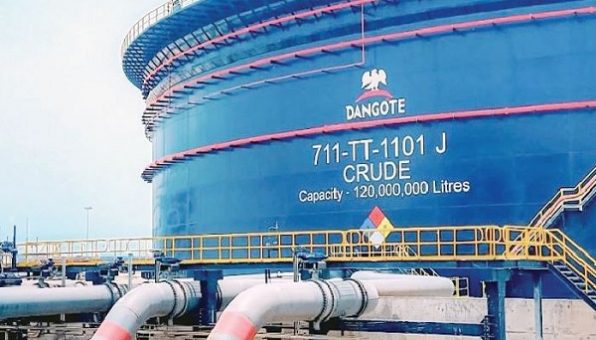
Dangote Refinery Plc has dismissed claims that its pricing structure favours MRS Oil Nigeria Plc or undermines competition in Nigeria’s downstream petroleum market, stressing that all marketers purchase products under the same conditions at the refinery gate.
The newly appointed Managing Director of Dangote Refinery Plc, David Bird, made the clarification on Wednesday during a press briefing at the refinery complex in Lagos, following public concerns over the retail pump price of petrol reportedly sold by MRS at ₦739 per litre.
Responding to questions on whether the pricing arrangement amounted to market distortion or anti-competitive conduct, Bird said the refinery neither determines retail prices nor offers preferential treatment to any marketer.
“I can’t comment on retail pricing. All I can assure you is that there is zero preferential pricing. Every truck that leaves this site has purchased a product at ₦699 ex-gate from a refinery perspective. There is no differentiation among customers,” he said.
Bird explained that Nigeria’s downstream petroleum sector is fully deregulated, allowing marketers to independently set their pump prices based on their cost structures and business strategies.
“What a marketer chooses to do and post as their retail price is entirely up to them. It is a fully competitive market, and the consumer has the choice to decide where to buy fuel, whether based on convenience, brand loyalty or proximity,” he added.
He further emphasised that MRS does not enjoy any special pricing advantage, noting that decisions around direct lifting and distribution are commercial choices linked to efficiency, compliance, and product quality.
“One thing I would add is the importance of understanding the original source of the product consumers are buying. We have a very strong regulator that drives compliance to fuel quality, and consumers should be assured that when they buy from any petrol station, they are getting the same quality product,” Bird said.
On domestic supply, the Dangote Refinery boss disclosed that the facility is currently producing about 50 million litres of fuel daily, adding that it has the capacity to meet Nigeria’s fuel needs despite recent demand volatility.
“There has been a lot of speculation about what the true Nigerian demand is. I’m not going to speculate on that. Demand has faced disruptions from pricing changes and currency devaluation, leading at times to volatility and even demand destruction,” he said.
Bird, however, expressed confidence that stable pricing and the availability of affordable, high-quality fuel would support a recovery in consumption.
“Looking forward, abundant, cheap, high-quality fuel will bring stability, and that stability should enable demand growth to recommence. We are well-positioned to meet any potential growth in demand over the next three years, and post-expansion, our production capacity will more than meet that demand,” he stated.
He also dismissed speculation about operational disruptions at the refinery, assuring stakeholders that production levels have remained consistent.
“We have continued to deliver 50 million litres a day. Whenever offtake has required it, marketers have been able to lift those volumes,” Bird said.