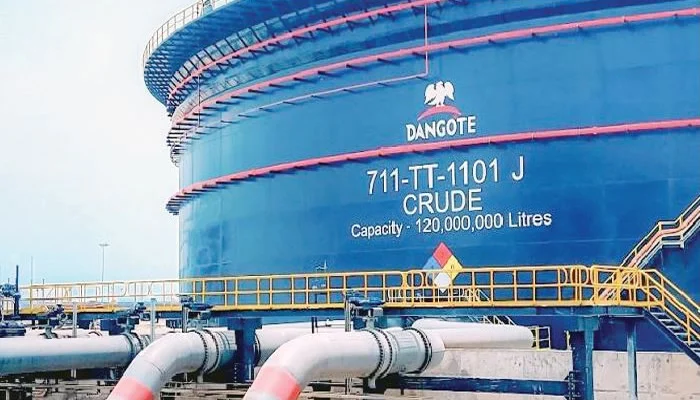
Nigeria’s fuel supply landscape is undergoing a major transformation as the Dangote Petroleum Refinery now accounts for about 92 per cent of the nation’s daily petrol supply, following the Federal Government’s decision to pause the importation of Premium Motor Spirit (petrol).
Despite a N100 reduction in the gantry price by the Dangote refinery, filling stations across the country on Tuesday continued to sell petrol at above N1,200 per litre, leaving many motorists without immediate relief at the pumps.
Multiple sources at the Nigerian Midstream and Downstream Petroleum Regulatory Authority (NMDPRA) and among major fuel-importing companies confirmed that no import licences have been issued so far in 2026.
According to officials at the regulatory agency, the halt in import licences is largely due to the ability of local refineries to meet Nigeria’s fuel demand.
“It’s correct that we’ve not issued import licences this year. Local production has met national requirements, so there’s no need for importation,” a senior NMDPRA official said, speaking anonymously due to lack of authorisation to comment publicly.
Data from the NMDPRA’s February 2026 fact sheet shows that local refineries supplied 36.5 million litres of petrol per day, while imports contributed only three million litres daily.
This pushed Nigeria’s total daily petrol supply to 39.5 million litres, with domestic refining accounting for roughly 92 per cent of the total supply—a sharp departure from the country’s long-standing reliance on imported fuel.
Currently, the Dangote refinery remains the only facility producing petrol in Nigeria, while other modular refineries are largely focused on refining crude oil into Automotive Gas Oil (diesel).
In contrast, January 2026 saw petrol imports average 24.8 million litres per day, while domestic refineries supplied 40.1 million litres daily, bringing total supply to 64.9 million litres per day.
The regulator noted that the drastic cut in imports caused a decline in overall supply in February.
“PMS supply in February 2026 reduced by 25.4 million litres per day due to a significant drop in imports,” the NMDPRA report stated.
The shift marks a significant restructuring of Nigeria’s fuel supply chain, with local refining—particularly production from the Dangote refinery—now dominating the market.
Historically, imported petrol accounted for a large share of Nigeria’s fuel supply. For example, in December 2025, imports averaged 42.2 million litres per day, compared with 32 million litres per day from domestic refineries.
Earlier in 2025, total daily supply ranged from 43.7 million litres in January to 57.1 million litres in May, with domestic refineries contributing between 18 and 25 million litres per day, representing 32 to 47 per cent of the market.
Imports filled the gap, peaking at 38.6 million litres per day in May 2025 as demand surged.
The lowest supply level was recorded in September 2025, when total daily supply fell to 39.7 million litres. During that period, the Dangote refinery supplied 17.6 million litres daily, while 22.1 million litres were imported to meet national demand.
Regulators said the shortage at the time prompted the approval of additional import licences to stabilise the market.
However, the latest data suggests that Nigeria is gradually moving toward fuel self-sufficiency, with local refining capacity increasingly meeting the country’s petrol needs.