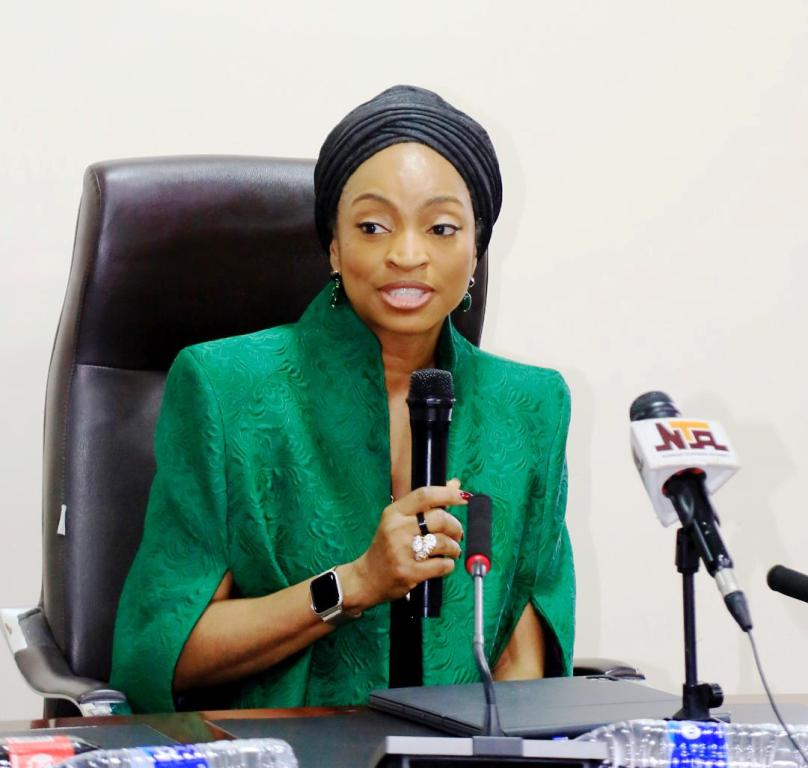
The Federal Government will prioritise the expansion of non-oil exports in 2026 as part of efforts to deepen economic diversification, the Minister of Industry, Trade and Investment, Dr Jumoke Oduwole, has said.
Oduwole disclosed this on Wednesday at the National Assembly Complex in Abuja during the appraisal of the ministry’s 2025 budget and the defence of its 2026 budget proposal.
The minister, who appeared before the Joint House of Representatives Committee on Trade, Industry and Small and Medium Scale Enterprises, described 2025 as a year of significant gains in trade and investment. She said the focus in 2026 would be on consolidating those achievements, particularly in investment mobilisation and export promotion.
Speaking with journalists after the session, Oduwole said the ministry would embark on a nationwide tour across the six geo-political zones to promote trade facilitation.
“This idea is to push the renewed hope agenda number seven, which is diversification of non-oil exports. Nigeria’s exports have already increased by 14 per cent compared to the rest of Africa, and this is one of the highest we’ve ever achieved,” she said.
According to her, non-oil exports recorded their highest level last year, gaining over $6bn in terms of both volume and value.
“We’ve never had it so good. Export is the way to go. We have our agricultural products. All we have to do is package them and push them to the rest of the world,” she added.
On local investment, the minister outlined plans to strengthen domestic participation while attracting foreign capital under what she described as the “Nigeria First” agenda.
“The Nigeria first agenda is to support domestic investors, making sure that we also bring foreign investors into Nigeria. The ministry will be going around to all six geopolitical zones to galvanise efforts on trade facilitation. We will be working with state governors and local government areas as well,” she said.
Providing an update on capital inflows, Oduwole revealed that Nigeria recorded total capital importation of approximately $21bn in the first ten months of 2025. This represents an increase from about $12bn in 2024 and under $4bn in 2023.
She attributed the recovery to the ministry’s initiatives, including the curation of over $5bn in bankable projects, sector-specific deal rooms, and Nigeria’s inaugural Domestic Investors’ Summit.
On industrial development, the minister said special economic zones generated over $500m in export revenues and created more than 20,000 direct jobs. She also disclosed that the Federal Executive Council approved the National Industrial Policy in November 2025.
“These activities helped re-engage domestic capital and facilitated the resolution of about 50 investor bottlenecks, driving projects from intention to implementation,” she said.
On trade performance, Oduwole stated that Nigeria recorded a trade surplus in 2025, with total trade valued at approximately N113tn in the first three quarters of the year.
Turning to the 2026 budget proposal, she said the ministry would focus on programmes aimed at stimulating economic growth and strengthening industrial capacity.
“We are poised to strengthen Nigeria’s productive base, as we connect global and regional demand and capital with domestic supply capacity, in support of national development priorities,” she said.
“In 2026, the ministry will focus on implementation, advancing industrial policy through targeted value chain and industrial cluster development and special economic zones.”
She disclosed that the ministry’s proposed capital allocation for 2026 stands at N2.72bn.
Earlier, the Chairman of the House Committee on Commerce, Ahmed Munir, said the National Assembly would intensify its oversight functions in the 2026 fiscal year.
“In the 2026 cycle, our oversight will not be business as usual. We are looking beyond ‘budget performance’ in terms of mere fund exhaustion; we are looking for value-for-money and tangible impact,” Munir said.
He added that the committee’s priorities would focus on domestic production, SMEs empowerment, and trade expansion.