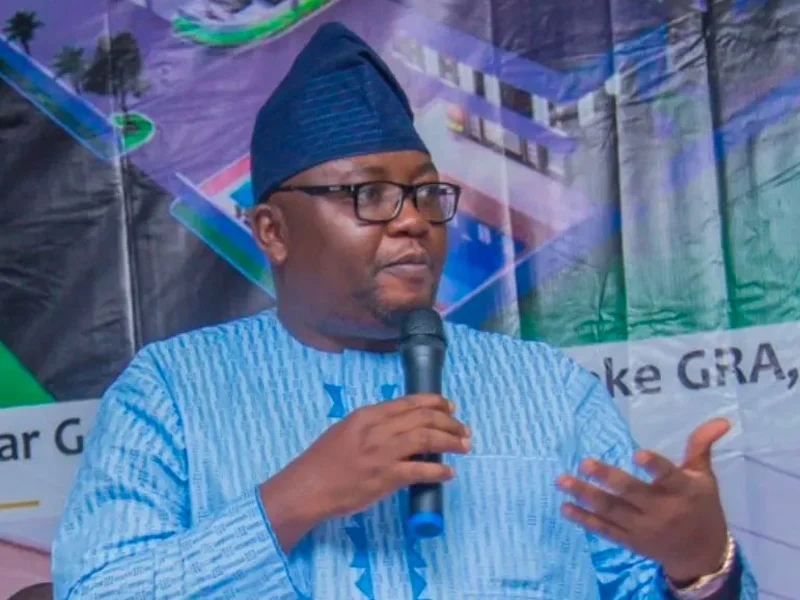
Power generation in Nigeria has remained below expected levels, despite assurances by the Minister of Power, Adebayo Adelabu, that the ongoing electricity outages would be resolved within two weeks.
Although there have been marginal improvements in some areas, electricity supply has largely fluctuated between 3,000 and 4,000 megawatts, leaving many households and businesses across the country without reliable power.
Checks by our correspondent showed that while a few locations recorded slight gains in supply, many Nigerians are still in darkness, hoping for restoration of electricity in their communities.
The recent outages followed weeks of disruptions caused by gas shortages affecting thermal power plants. Power distribution companies had repeatedly apologised to customers and promised relief, which many consumers say has yet to materialise.
Speaking on the development, the Chief Executive Officer of the Association of Power Generation Companies, Joy Ogaji, said gas suppliers had warned generation companies that they would stop supplying gas to thermal plants unless outstanding payments were settled.
Two weeks ago, Adelabu publicly apologised to Nigerians during a press conference in Abuja over the erratic electricity supply.
“I want to apologise to Nigerians, officially now, coming from me as the minister of power, for this temporary issue that is leading to hardship being experienced, especially during this dry season where there is so much heat everywhere,” the minister said.
He noted that businesses, schools, and industries had been affected by the disruption but assured citizens that relief was imminent.
“With the committee that we have set up, commitments from gas suppliers, and the timeline for the repair of the gas pipelines, two weeks from now we should start seeing improvements in supply,” Adelabu had said.
However, as the two-week deadline expired, electricity supply across the national grid has yet to return to the levels recorded in 2025, when generation frequently exceeded 5,000 megawatts.
As of Wednesday morning, the country’s 11 electricity distribution companies were struggling to distribute about 3,500MW to consumers nationwide. Although this marks a slight improvement from the 2,900MW recorded at the peak of the crisis, many Nigerians say the promised improvements are yet to be felt.
Real-time power generation has continued to hover between 3,000MW and 4,000MW.
Operators in the generation segment also accused distribution companies of rejecting electricity loads allocated to them, resulting in significant financial losses.
Ogaji confirmed that the system operator had, at times, instructed generation companies to reduce output due to load rejection by distribution companies.
“DisCos are not taking load; hence, there is high frequency,” she said, adding that the gas shortage was not the only factor responsible for the current low generation.
According to her, Nigeria has about 30 grid-connected power plants with an installed capacity of 15,500MW. However, due to huge debts owed to generation companies, only about 7,000MW can currently be made available.
Out of that capacity, the Transmission Company of Nigeria and distribution companies can off-take only about 4,000MW to 4,500MW, a limitation that has persisted since 2013.
She added that in January, the average generation stood at 4,541MW, with about 2,985MW stranded, while February recorded an average generation of 4,218MW, out of which 3,274MW was not taken by distributors.
Distribution companies, however, rejected accusations of deliberate load rejection. Operators within the sector said power is sometimes rejected because the transmission system fails to deliver electricity to the locations where it is needed.
The disagreement has also drawn in the Transmission Company of Nigeria, which recently stated that its verified transmission wheeling capacity has increased to 8,700MW.
The company said this expansion followed significant infrastructure investments, including transformer installations, substation construction, and transmission line upgrades.
Despite the claims and counter-claims among operators in the generation, transmission, and distribution segments, millions of Nigerian homes and businesses continue to wait for improved electricity supply.
With generation still fluctuating below previous levels and structural challenges unresolved, uncertainty remains over when the government’s promise of stable electricity will be achieved.