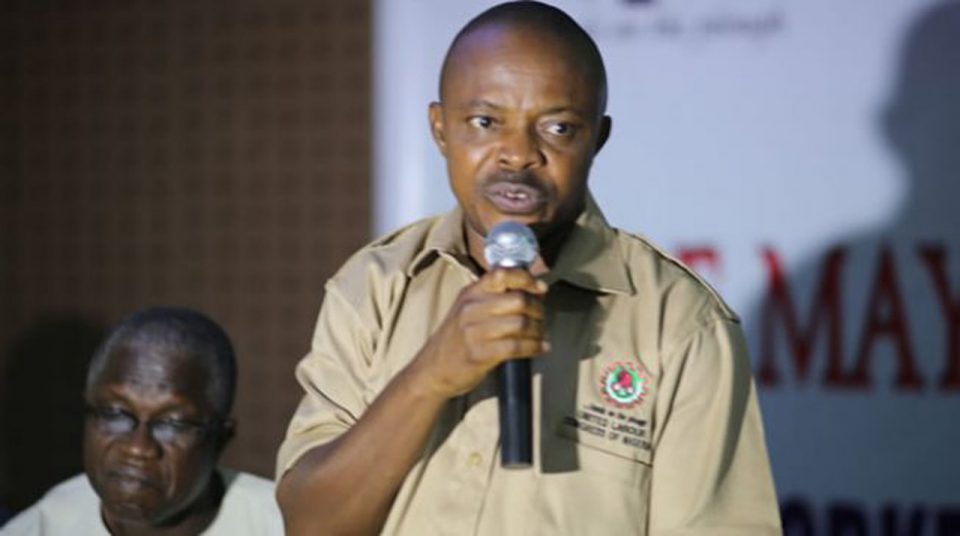
The Nigeria Labour Congress (NLC) has rejected the Federal Government’s proposed N6tn bailout for power generation companies, describing it as a temporary fix that fails to address Nigeria’s deep-rooted electricity challenges.
NLC President, Joe Ajaero, said the country’s power sector has become a heavy burden on workers, businesses, and ordinary citizens, accusing political elites and industry players of exploiting the system through inflated subsidy claims and high tariffs.
“The nation’s power sector has become a perpetual millstone around the necks of Nigerian workers… while ordinary Nigerians are left to pay for darkness,” Ajaero stated.
The union argued that the bailout is merely a symptom of a larger structural problem and proposed a radical reform — merging the Federal Ministry of Petroleum and the Federal Ministry of Power into a single Ministry of Energy.
According to the NLC, such a move would eliminate bureaucratic silos, improve accountability, and prioritise domestic electricity supply over private sector profits.
“Our commonwealth cannot be used to settle a cartel of failed investors,” the union said, while also calling for a national stakeholders’ summit to develop a “People’s Power Roadmap.”
Nigeria’s electricity sector has faced worsening instability in recent weeks, with frequent grid collapses, plant shutdowns, and low generation capacity. Reports indicate that about 16 of the country’s 33 power plants went offline in mid-March 2026 due to gas supply disruptions linked to debts exceeding N3tn owed to suppliers.
Power generation has since dropped to between 3,700 and 4,000 megawatts, far below the country’s installed capacity of over 13,000 MW. Generation companies (GenCos) say cumulative debts of about N6.5tn are crippling operations.
The NLC criticised the disconnect between the petroleum and power sectors, noting that while Nigeria exports gas for foreign exchange, local power plants struggle to access fuel needed for electricity generation.
“The nation’s thermal power generation… is held hostage by gas supply gaps,” the union said, adding that the petroleum sector operates with little accountability to domestic energy needs.
The labour body maintained that a unified Ministry of Energy would ensure coordinated planning, prioritise gas for local electricity generation, and drive industrial growth.
It also called for a shift from the current “cost-reflective tariff” model to a “service-reflective tariff” system, where consumers pay based on actual electricity supply rather than inefficiencies in the system.
The NLC further criticised the 2013 privatisation of the power sector, arguing that it has failed to improve generation capacity despite the sale of assets for about N400bn.
The proposed bailout stems from long-standing debts owed to GenCos through the Nigerian Bulk Electricity Trading Plc, with monthly invoices averaging N280bn but often only partially settled.
While the government, led by Bola Tinubu, has previously approved partial payments to address the debt backlog, the NLC insists that continued bailouts will not resolve the sector’s fundamental issues.
The union urged the government to halt the bailout, pursue structural reforms, and prioritise energy security and public welfare over private interests.
“The working class and the people of Nigeria cannot continue to be hostages to artificial scarcity,” Ajaero said. “It is time to unify the vision and take back the power sector for our nation.”