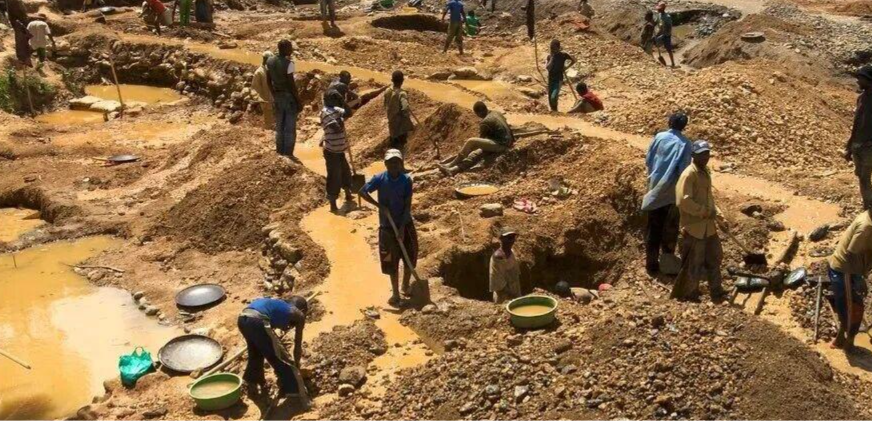
Authorities in Guinea have sentenced 224 people to prison over illegal gold mining activities in the country’s northeastern Siguiri region as the government intensifies its campaign against unauthorised mining and environmental destruction.
The sentences were handed down by a court following investigations into illegal mining operations, environmental degradation and the alleged involvement of former local officials in activities that damaged farmland and polluted water sources.
According to reports by the Associated Press, 22 former local officials were sentenced to two years in prison and fined 10 million Guinean francs each for their involvement in environmental degradation, destruction and water pollution.
Another 202 people, including foreign nationals, received three-year prison sentences for illegal mining and related environmental offences.
The court also ordered the miners to pay a combined fine of 10 billion Guinean francs. Foreign defendants were additionally prohibited from entering Guinea for 10 years.
The convictions represent a major development in the government’s efforts to strengthen control over the country’s mineral resources and address the environmental consequences of unregulated mining.
Siguiri is one of Guinea’s most important gold-producing areas and has attracted thousands of miners seeking employment and business opportunities.
However, the expansion of unauthorised mining activities has created serious environmental challenges, particularly in communities where mining operations take place close to farms, rivers and residential areas.
Mining activities that are carried out without proper environmental safeguards can destroy agricultural land, contaminate water sources and expose surrounding communities to dangerous substances.
The government has argued that stronger enforcement is necessary to protect natural resources and ensure that mineral extraction contributes more effectively to national development.
The crackdown has also targeted individuals accused of providing support or protection to illegal mining operators.
Authorities have reportedly arrested more than 1,200 people in Siguiri as part of the wider enforcement campaign.
The government has also taken action against local officials accused of enabling unauthorised mining activities.
However, the enforcement operation has generated tension between authorities and mining communities.
Last week, clashes between security forces and protesters in the region reportedly resulted in 10 deaths and 13 injuries.
The violence demonstrates the difficulties associated with implementing restrictions in communities where artisanal mining provides an important source of income.
According to information from the United Nations Environment Programme cited in the Associated Press report, illegal gold mining supports more than 300,000 people in Guinea.
For many households, artisanal mining represents an important economic activity, particularly in areas where formal employment opportunities are limited.
The government’s campaign has therefore raised questions about how authorities can balance environmental protection with the economic needs of communities that depend on mining.
The crackdown has also affected foreign miners, particularly individuals from neighbouring Burkina Faso.
Reports indicate that tens of thousands of miners and family members have moved towards neighbouring Mali following enforcement operations.
The development could create additional economic and humanitarian challenges in border communities.
Guinea is one of West Africa’s major mineral-producing countries, with significant deposits of gold, bauxite and iron ore.
The government has been working to increase the country’s control over natural resources and encourage greater domestic processing of minerals.
Its wider resource-management strategy includes efforts to improve revenue collection, reduce illegal mineral trading and attract investment into the mining industry.
However, analysts have warned that enforcement measures must be accompanied by clear regulations, transparent licensing procedures and alternative economic opportunities for affected communities.
Without these measures, restrictions could increase unemployment and encourage further informal mining activities.
The government will also need to strengthen environmental monitoring and ensure that mining companies and artisanal operators comply with established standards.
The latest convictions highlight the growing importance of responsible mineral extraction in Guinea.
As the campaign continues, attention will focus on whether the government can reduce illegal mining while protecting livelihoods and maintaining stability in affected communities.