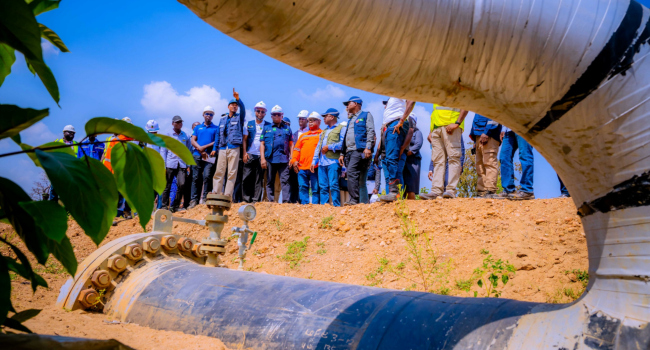
Nigeria’s long-delayed $2.8 billion Ajaokuta–Kaduna–Kano (AKK) gas pipeline is expected to begin delivering natural gas to Abuja in July, according to the Nigerian Upstream Petroleum Regulatory Commission (NUPRC).
The development marks a significant milestone in the country’s strategy to expand gas infrastructure and deepen the use of natural gas as a cleaner and more reliable energy source.
A spokesperson for the commission told Reuters that the government is optimistic the pipeline will begin supplying gas to the federal capital within the coming months.
“We’re hoping that by July, gas will be delivered to Abuja through the AKK gas pipeline,” the spokesperson said.
The Ajaokuta–Kaduna–Kano Gas Pipeline, popularly known as the AKK pipeline, is a 614-kilometre pipeline designed to transport more than 2.2 billion cubic feet of gas per day.
It forms a key component of Nigeria’s broader plan to shift its energy mix towards natural gas while expanding supply to industries and power plants in northern parts of the country.
Once fully operational, the pipeline is expected to support electricity generation and industrial activity across northern Nigeria, while also reducing dependence on diesel and fuel oil.
Nigeria holds one of the largest natural gas reserves in the world, estimated at more than 210 trillion cubic feet, positioning the country as a major potential supplier in global energy markets.
The AKK pipeline project was first conceived in 2008 but has experienced several delays over the years. Earlier completion targets set for 2023 and the fourth quarter of 2025 were missed.
Construction eventually began in 2020 under the supervision of the Nigerian National Petroleum Company Limited (NNPC), but progress was slowed by funding challenges and complex engineering works, including the crossing of the River Niger.
However, an energy lawyer familiar with the project told Reuters that the pipeline is now at an advanced stage, with more than 90 percent of the construction completed.
Gas transported through the pipeline will be sourced primarily from southern producing regions through its connection to the Obiafu–Obrikom–Oben Gas Pipeline (OB3), which links key gas supply hubs in the Niger Delta.
The AKK pipeline is widely seen as a crucial infrastructure project for improving energy access, promoting industrialisation, and supporting Nigeria’s transition to a gas-driven economy.