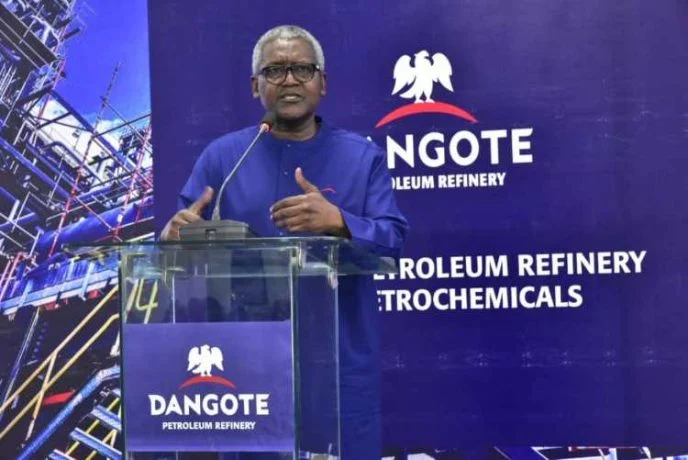
Africa’s richest man, Aliko Dangote, has unveiled plans to build a new 650,000 barrels-per-day refinery in East Africa, signalling an ambitious expansion of his refining operations beyond Nigeria.
Dangote made the announcement during a presidential panel at the Africa We Build Summit, organised by the Africa Finance Corporation in Nairobi on Thursday.
He said his company is ready to replicate the scale and operational model of its Lagos-based refinery in East Africa if governments in the region provide the necessary support.
Dangote called on East African leaders to back the initiative, noting that the project could significantly reshape fuel supply across the region.
“We can give commitment to the presidents here today that if they support the refinery, we will build the identical one that we have in Nigeria, a 650,000 barrels-per-day refinery,” he said.
“The discussions are still early, but it will work. There is nothing that can stop it. We have done it before in Nigeria, and that is why we are taking this bold step again.”
His remarks come as East African nations intensify talks to establish a joint refining hub in the Tanzanian port city of Tanga. The project is expected to process crude oil from across the region, including supplies from the Democratic Republic of the Congo and South Sudan.
Dangote also disclosed that his group has already commenced expansion works in Nigeria aimed at raising the refining capacity of its facility to 1.4 million barrels per day.
According to him, the upgrade would position the plant as the largest refinery in the world once completed.
“We have already started piling for the expansion. We are building it to a scale of 1.4 million barrels per day. It will be the largest refinery globally,” he said.
The billionaire industrialist stressed that Africa must prioritise industrial self-sufficiency to shield its economies from global supply shocks.
He cited recent volatility in the petrochemical market, noting that prices for polypropylene surged sharply within a short period, demonstrating the risks of excessive reliance on imports.
“If not for local production of polypropylene in Nigeria, many businesses would have collapsed. Cement packaging, flour, rice, grains—everything depends on it,” he said.
Dangote added that the proposed refinery would deepen Africa’s refining capacity while unlocking new investment opportunities on the continent.
He also revealed plans to open up ownership of the refinery business to African investors, promising dollar-denominated returns to deepen participation in critical infrastructure projects.
“We want all Africans to invest. This is a continental asset, and we will be paying dividends in dollars,” he said.
On the project timeline, Dangote said the refinery could be delivered within four to five years once agreements are finalised with regional governments.
Earlier, Kenya’s President, William Ruto, confirmed that discussions were ongoing with Dangote and regional partners to establish a joint refinery in Tanga.
Ruto said the proposed facility would process crude oil from several countries and strengthen energy security across East Africa.
“We are going to have a joint refinery in Tanga to benefit all of us because that refinery will take crude from the DRC, Kenya, South Sudan, and Uganda,” he said.
The president also disclosed that the project would be supported by a pipeline linking Kenya’s coastal city of Mombasa to Tanga to ensure a steady supply of crude to the refinery.
Industry data shows that about 75 per cent of refined petroleum products consumed in East and Southern Africa are currently imported, largely from the Middle East. This dependence exposes the region to supply disruptions and price spikes during geopolitical tensions.
The planned refinery comes as Uganda advances its own refining ambitions after signing a deal in 2024 with UAE-based Alpha MBM Investments to develop a 60,000 barrels-per-day plant.
Dangote’s expansion builds on the rollout of his 650,000 barrels-per-day refinery in Lagos, which began operations in 2024 and is designed to meet Nigeria’s domestic fuel demand while exporting surplus products.
Beyond refining, Dangote also announced plans to establish about 20 fertiliser blending plants across Africa by 2028, further expanding his industrial footprint across the continent.
Energy analysts say the proposed East African refinery could significantly alter Africa’s fuel supply dynamics, reduce reliance on imported petroleum products, and strengthen regional energy security if successfully executed.