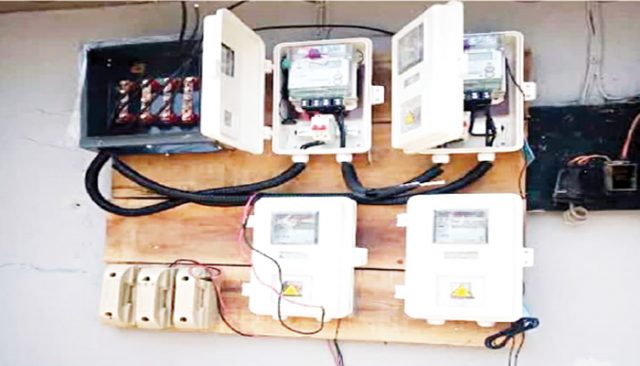
Electricity distribution companies in Nigeria have installed more than 130,000 meters under the Meter Acquisition Fund framework as the Federal Government invested about N49bn into the scheme between 2024 and 2025.
Reports and documents from the Nigerian Electricity Regulatory Commission show that the intervention was introduced to address persistent financing challenges faced by electricity distribution companies in deploying end-use meters.
The Meter Acquisition Fund was designed to strengthen the creditworthiness of the distribution companies by creating a reliable revenue stream from market funds. The initiative aims to help utilities attract long-term financing for large-scale meter deployment across the country.
Under the framework, the management of the fund is handled by a designated fund manager operating under terms negotiated by the distribution companies and approved by the Nigerian Electricity Regulatory Commission.
Since 2024, the commission has also rolled out the disbursement of free prepaid meters to Band A customers under the first tranche of the scheme.
In 2024, the regulator approved N21bn for meter deployment, while another N28bn was disbursed in 2025 as the second tranche of the programme.
Data from the commission indicates that installations started modestly in 2024, with 5,068 meters deployed across a few distribution companies.
However, installations rose significantly in 2025. The first quarter recorded 36,903 meter installations nationwide, while the second quarter witnessed a peak of 65,315 units deployed.
Deployment dropped sharply in the third quarter to just 175 installations before rebounding in the fourth quarter with 22,748 meters installed.
Among the distribution companies, Ikeja Electric led the deployment efforts with a total of 31,331 meters installed since 2024. The company recorded its strongest performance in the second quarter of 2025 with 21,004 installations.
Enugu Electricity Distribution Company followed with 14,822 meters installed, with most deployments occurring in the fourth quarter of 2025. Eko Electricity Distribution Company installed 14,501 meters in the second quarter of the same year.
Ibadan Electricity Distribution Company recorded 12,556 installations, while Port Harcourt DisCo deployed 11,445 meters. Abuja Electricity Distribution Company installed 11,375 meters, with a notable rise in the final quarter of 2025.
Other distribution companies such as Benin, Jos, and Kano also reported significant installation numbers, although Yola and Kaduna recorded comparatively lower figures during the reporting period.
The Meter Acquisition Fund operates alongside the Federal Government’s Presidential Metering Initiative, which targets closing Nigeria’s metering gap within three years through the deployment of smart metering technologies.
The Chairman of the Nigerian Electricity Regulatory Commission, Musiliu Oseni, recently explained that meters provided under government-funded initiatives are free at the point of installation.
Speaking during a radio programme on Fresh FM, Oseni said the regulator introduced several initiatives after discovering that distribution companies were struggling to secure financing from banks.
According to him, lenders typically evaluate the financial records of the utilities before granting loans, which made it difficult for the companies to access funding for meter deployment.
Oseni also clarified that customers who previously paid upfront for meters under approved schemes are entitled to refunds once their payments are verified.
He noted that customers who receive government-funded meters will not be paid refunds because the cost of the meters is already factored into electricity tariffs.
In October 2025, the commission approved the disbursement of N28bn for the second phase of the Meter Acquisition Fund scheme to provide free meters to all outstanding Band A customers.
The regulator explained that the second tranche of the scheme would focus on closing the metering gap among Band A customers while also accelerating deployment for customers under tariff Band B.
According to the commission’s order, all meters procured and installed under the scheme must be provided at no cost to customers.
The order also set a deadline of December 31, 2025, for distribution companies to complete all installations funded under the second tranche of the programme.
The regulator warned that distribution companies would face penalties if delays occur due to their own failures, such as not providing network clearance or submitting accurate customer information.
Despite these efforts, many Band A customers were still on estimated billing as of the first quarter of 2026 due to challenges including meter importation delays and a shortage of qualified installers.
Meanwhile, the commission disclosed that a significant number of customers had also funded their own meters.
According to the regulator, 508,101 customers purchased meters in 2024, while 650,187 customers paid for meters in 2025, bringing the total to 1,158,288 customer-funded meters within the two-year period.
However, Nigeria still faces a significant metering gap.
The commission’s fourth-quarter 2025 report revealed that metering coverage stood at 57.27 per cent as of December 2025.
Out of 12,163,412 active electricity customers across the country’s 11 distribution companies, only 6,966,584 had been metered by the end of the year.
This means that about 5.2 million electricity customers across Nigeria were still on estimated billing despite ongoing interventions to improve metering coverage.