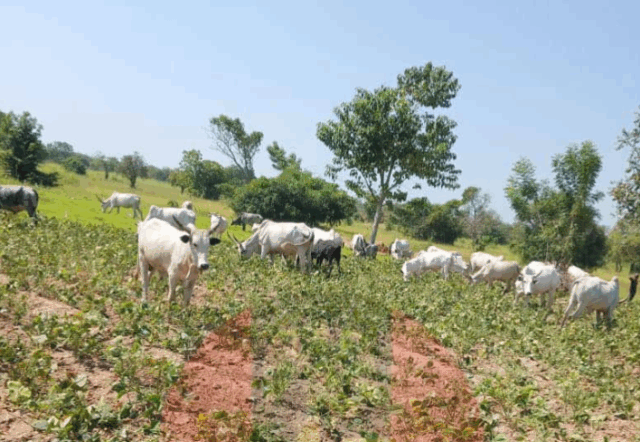
The Federal Government has begun the revival of grazing reserves and ranches across Nigeria as part of efforts to reduce recurring clashes between farmers and herders.
The Senior Special Assistant to the President on Livestock Development, Idris Ajimobi, disclosed this on Wednesday during an interactive session with journalists in Ibadan, Oyo State.
Ajimobi said the initiative is being carried out in partnership with the Ministry of Livestock Development and is focused on modernising livestock production systems across the country.
According to him, work has already started on the Kawu Grazing Reserve in Abuja, while authorities are conducting a nationwide audit of ranches and the country’s 417 grazing reserves to determine which facilities can be upgraded.
“It’s not just about teaching farmers modern ways of farming. If we teach without providing the necessary infrastructure, we are wasting our time,” Ajimobi said.
“Our intention is to teach, revive the reserves we have, modernize them, and use them as a platform to begin the ranching system that the government wants.”
He explained that the government believes the ranching system can help reduce long-standing conflicts between farmers and herders, noting that similar systems have worked successfully in other countries.
Ajimobi revealed that the grazing reserves are larger and more difficult to rehabilitate than initially expected, but assured that progress is ongoing.
“We have 417 grazing reserves, and they are more challenging than we would have thought. They are very big, but we are working on reviving them,” he stated.
He added that the government has engaged private sector investors and international development partners to support the revival projects.
The presidential aide also said President Bola Tinubu’s administration remains committed to achieving food security in Nigeria, which he described as one of the reasons behind the creation of the Ministry of Livestock Development.
Ajimobi disclosed that President Tinubu has set a nutrition target aimed at ensuring that every Nigerian child has access to “a sachet of milk and one egg every day.”
Speaking on insecurity affecting forests and farmlands, Ajimobi said addressing banditry and kidnapping requires joint efforts between government and local communities.
“Government has a role to play, but the communities also have a role to play. We are confident that together we can address these challenges,” he said.
He noted that improving livestock management and involving community members in ranger operations would complement the work of security agencies.
On foreign investments in the livestock sector, Ajimobi listed several recent agreements secured by the Federal Government, including a $1.5 billion investment deal with JBS, the world’s largest beef processor.
He also mentioned a cooperation agreement with France on livestock and agriculture, as well as a £100 million dairy production and processing partnership signed during President Tinubu’s recent visit to the United Kingdom.
Ajimobi further revealed that Saudi Arabia has shown interest in importing Nigerian bovine red meat, with discussions currently ongoing to begin exports.