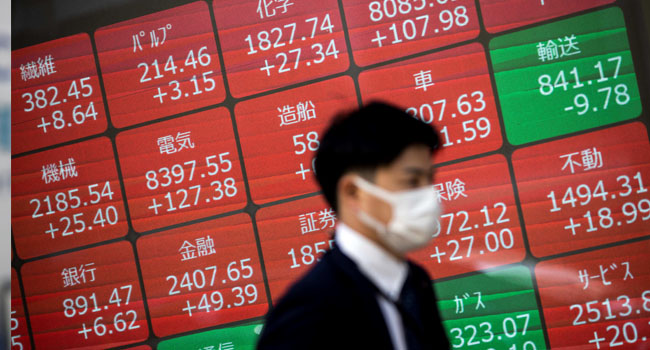
Asian stocks rose on Wednesday as falling oil prices pushed bond yields lower amid growing hopes that the critical Strait of Hormuz could reopen, while investors awaited another closely watched earnings report from artificial intelligence chipmaker Nvidia.
Iran said it had resumed talks with Oman on managing the Strait of Hormuz as it faces increased economic pressure from US President Donald Trump during the nearly six-month conflict that has disrupted oil markets and raised concerns about global inflation.
Brent crude futures fell for a third consecutive day, declining more than 2 per cent to $86.41 per barrel on Wednesday. The decline came amid expectations that additional oil supplies could move through the Strait, which handled about one-fifth of the world’s traded oil before the conflict.
The drop in oil prices also helped push bond yields lower. The yield on US 10-year Treasury notes stood at 4.634 per cent after falling 6.5 basis points on Tuesday.
“While there was no real progress or details of the Iran-Oman deal, as Iran reiterated that Hormuz will remain shut until conditions are met, price action suggested that markets are quickly pricing in optimism around an interim announcement,” analysts at J.P. Morgan said.
Investors also turned their attention to Nvidia’s second-quarter earnings, with markets focused on whether the massive investment boom in artificial intelligence can continue generating profits strong enough to meet elevated expectations.
MSCI’s broadest index of Asia-Pacific shares outside Japan rose 0.85 per cent. Japan’s Nikkei gained 0.7 per cent, while South Korea’s tech-heavy KOSPI advanced 1 per cent.
Nasdaq futures declined 0.15 per cent, while European futures gained 0.15 per cent.
Analysts said Nvidia’s latest results could face a higher bar because investors have increasingly come to expect the company to exceed forecasts.
“Nvidia is approaching the point where beating expectations is expected, so the headline numbers alone may not determine the market reaction,” said Charu Chanana, chief investment strategist at Saxo in Singapore.
“The question is less whether Nvidia beats and more how big the beat is and whether guidance is strong enough to keep earnings expectations moving higher,” Chanana added.
Analysts expect Nvidia to forecast an 82.8 per cent increase in third-quarter sales to $104.20bn. Adjusted gross margins for the second and third quarters are expected to remain around 75 per cent.
J.P. Morgan analysts said Nvidia’s earnings were likely to remain “supportive of the AI trade”, although they did not expect the results to provide a significant near-term boost to the semiconductor sector.
Options market data also pointed to a potentially smaller share-price move following the earnings announcement compared with previous results, suggesting that Nvidia’s financial performance may be becoming more predictable for investors.
Currency markets remained relatively calm, with the US dollar holding steady after recent weakness as traders awaited fresh US inflation data later on Wednesday and prepared for the Federal Reserve’s Jackson Hole symposium later in the week.
The dollar index, which measures the US currency against six major currencies, stood at 98.934 and was on track for a 1 per cent decline in August.
Investors have also been monitoring the US Treasury’s efforts to ease pressure on longer-dated bond yields through an expansion of its debt buyback programme.
“While this will ease overall interest costs at the margin, it does not change the underlying drivers of rising interest payments: the U.S. government’s rising stock of debt and concerns about fiscal dominance/Fed independence,” said Kristina Clifton, an economist at Commonwealth Bank of Australia.
The Treasury’s move has also shifted some pressure towards the dollar, reviving what investors describe as the “debasement trade”. The strategy involves buying assets such as gold and bitcoin on expectations that rising government spending and debt could weaken the value of currencies.
Spot gold was last quoted at $4,646.08 per ounce, close to the three-month high reached in the previous session.
Bitcoin also rose 0.6 per cent to $78,704 as investors continued to monitor developments in global markets and monetary policy.