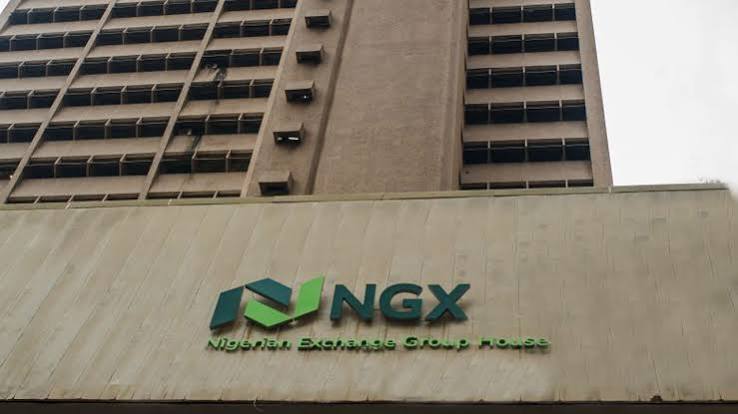
The Nigerian Exchange Limited (NGX) returned to negative territory on Wednesday as renewed selling pressure wiped approximately ₦515.95 billion off the market’s capitalisation, reversing the previous session’s gains.
The market’s total capitalisation fell from ₦159.67 trillion on Tuesday to ₦159.15 trillion, while the All-Share Index (ASI) declined by 794.64 points, or 0.32 per cent, to close at 245,116.49 points.
The downturn reflected weaker performance across several major sectors, with banking and insurance stocks among the areas under pressure.
Banking and insurance stocks weigh on sentiment
The NGX Banking Index fell by 1.49 per cent to 2,456.31 points, while the NGX Insurance Index declined by 1.41 per cent to 1,053.31 points.
The broader retreat suggests that investors remained cautious about selected equities, although individual share-price movements varied across the market.
The oil and gas sector provided some support, with the NGX Oil/Gas Index rising by 0.12 per cent to 6,197.74 points. Oando Plc advanced by 4.50 per cent, helping the sector close higher despite the broader market decline.
The mixed performance illustrates how gains in individual stocks and sectors can be outweighed by losses elsewhere, particularly when large or heavily traded companies come under selling pressure.
Trading activity remains active
Despite the fall in market value, investors continued to trade actively. Nairametrics reported that approximately 354.03 million shares changed hands across 32,514 deals during the session.
Livingtrust Mortgage Bank led the gainers, rising 9.90 per cent to close at ₦3.22, followed by ABC Transport, which gained 9.77 per cent to ₦7.30, and Meyer Plc, up 9.72 per cent to ₦17.50.
Computer Warehouse Group led the losers, falling 9.98 per cent to ₦18.05. UPDC Real Estate Investment Trust and Austin Laz & Company also recorded sharp declines.
The distribution of gains and losses indicates that the session was not a uniform sell-off across all listed companies, even though the benchmark index and overall market capitalisation declined.
What investors will be watching
Market participants will be monitoring corporate earnings, policy developments, interest-rate conditions and the performance of major listed stocks for signals about the direction of trading.
The latest decline does not, on its own, establish a sustained market reversal. Investors will need to assess whether selling pressure continues in subsequent sessions or whether buying interest returns to support prices.
For investors, the session reinforces the importance of assessing individual companies, their earnings prospects and risk exposure rather than relying exclusively on movements in the benchmark index.