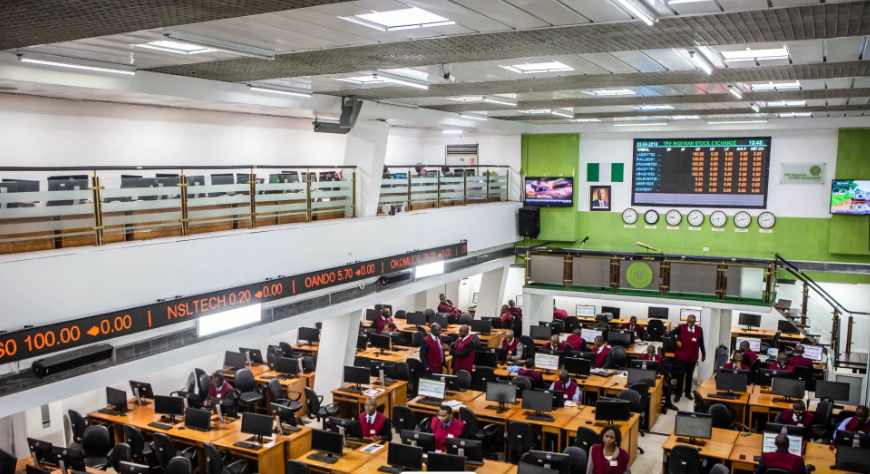
Nigeria’s equities market recorded a significant recovery in the trading week ended November 13, 2026, adding approximately ₦2.20 trillion to its market capitalisation as investors returned to selected stocks following heavy profit-taking in the previous week.
Data from the Nigerian Exchange (NGX) showed that market capitalisation increased to ₦163.795 trillion on Friday, November 13, compared with ₦161.593 trillion recorded on November 6. The increase represented a weekly appreciation of approximately 1.36 per cent.
Similarly, the NGX All-Share Index advanced by 1.36 per cent to close at 252,269.16 points, compared with 248,877.22 points recorded at the end of the previous week.
The recovery reversed part of the losses experienced during the preceding trading period, when investors reduced their exposure to several equities after a period of strong market appreciation.
The improved performance was supported by renewed buying interest in selected companies across the insurance, oil and gas, industrial goods and commodity sectors.
According to market reports, investors took advantage of lower share prices following the sharp market correction recorded earlier in the week. This created opportunities for investors seeking to purchase stocks at relatively cheaper prices.
However, the recovery was not entirely smooth, as the market experienced mixed trading sessions throughout the week.
The market recorded notable gains on Monday and Thursday, while trading activities moderated on Tuesday, Wednesday and Friday.
Friday’s session ended with a marginal decline of 0.04 per cent, as losses recorded by some major companies affected the overall performance of the market.
Financial stocks influence market performance
The financial services sector remained the most actively traded segment of the Nigerian equities market during the reporting period.
Investors exchanged approximately 8.03 billion shares valued at ₦185.36 billion in 160,836 deals.
Although the volume of shares traded increased significantly compared with the preceding week, the total value of transactions declined by 11.1 per cent from ₦208.41 billion.
The increase in trading volume alongside a decline in transaction value suggests that a larger number of shares changed hands at relatively lower average transaction values.
The financial services sector accounted for approximately 4.85 billion shares valued at ₦95.79 billion in 72,047 deals.
This represented 60.45 per cent of the total trading volume and 51.68 per cent of the total value of transactions recorded during the week.
The agriculture sector followed with approximately 2.24 billion shares valued at ₦22.78 billion, while the consumer goods sector recorded about 260.996 million shares worth ₦11.89 billion.
The figures demonstrate the continued importance of financial institutions and related companies in Nigeria’s capital market.
Banks and other financial services businesses remain major investment destinations because of their importance to the economy, particularly in lending, payments, deposits and corporate financing.
Champion Breweries leads the gainers
Champion Breweries Plc emerged as the best-performing stock during the week, recording an appreciation of 27.27 per cent as its share price increased from ₦8.80 to ₦11.20.
Caverton Offshore Support Group Plc followed with a 20.55 per cent gain, rising from ₦3.65 to ₦4.40.
AXA Mansard Insurance Plc appreciated by 16.10 per cent to close at ₦13.70, while Oando Plc gained 14.80 per cent to finish at ₦38 per share.
Veritas Kapital Assurance Plc also recorded a positive performance, appreciating by 14.74 per cent to close at ₦1.09.
These gains reflected renewed demand for selected equities, although individual share-price movements can be influenced by several factors, including company announcements, financial performance and investors’ expectations.
On the losing side, LivingTrust Mortgage Bank Plc recorded the largest decline, shedding 18.53 per cent as its share price fell from ₦2.86 to ₦2.33.
Thomas Wyatt Nigeria Plc declined by 12.31 per cent, while Okomu Oil Palm Company Plc lost 10.90 per cent.
The performance of these companies shows that the overall market recovery did not translate into gains for every listed business.
Market recovery follows a period of profit-taking
The latest recovery came after the Nigerian equities market experienced significant selling pressure.
Market capitalisation had declined by approximately ₦3.52 trillion following the strong appreciation recorded towards the end of October.
Some investors chose to sell shares to secure profits after prices increased considerably.
Profit-taking is a normal activity in financial markets. Investors who purchase shares at lower prices may decide to sell when the value increases, particularly when they believe prices have reached attractive levels.
Although this can temporarily reduce market values, it can also create opportunities for other investors to enter the market at lower prices.
The recovery recorded during the week suggests that some investors were willing to return to selected equities after the correction.
Implications for investors and the Nigerian economy
The performance of the NGX remains important to Nigeria’s financial system because the capital market provides businesses with opportunities to raise funds and gives investors access to ownership in listed companies.
A stronger equities market can improve investor confidence and support the ability of companies to attract long-term capital.
However, investors are expected to continue monitoring inflation, interest rates, foreign exchange conditions, corporate earnings and government economic policies when making investment decisions.
The latest increase in market capitalisation represents an improvement in the value of listed equities, but the sustainability of the recovery will depend on the financial performance of companies and the broader economic environment.
Investors will also be watching developments surrounding major corporate listings and the ability of the market to attract new domestic and international capital.
For now, the NGX has recovered part of its recent losses, but the mixed performance of individual sectors indicates that investors remain selective.
The coming trading sessions will provide further indications of whether the recovery can be sustained and spread across more sectors of the Nigerian economy.