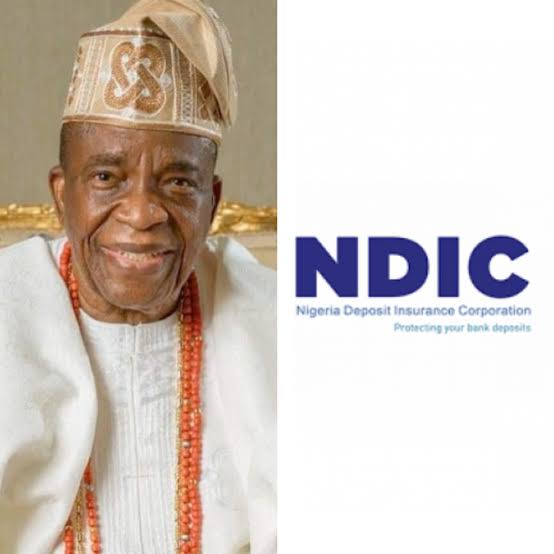
Former Chairman of the defunct City Express Bank, Prince Samuel Adedoyin, has rejected a recent publication by the Nigeria Deposit Insurance Corporation (NDIC), describing the report on the bank’s failure as false, biased, and defamatory.

Adedoyin, through his lawyer, A.O. Akinrimisi, said the NDIC report titled “Failure of City Express Bank” failed to reflect key court rulings and developments that occurred after the bank’s closure. He argued that the publication was “inaccurate, incomplete and one-sided,” alleging it was an attempt by the Corporation to shift blame from its own regulatory failures.
According to the statement, the NDIC omitted several crucial facts, including judgments of the Federal High Court that invalidated many of the Corporation’s claims. Akinrimisi cited Suit No. FHC/L/CS/87/2006, in which the court struck out NDIC’s unproven debt claims against Adedoyin and associated firms. He also referenced Suit No. FHC/L/CS/1690/2017, where the court restrained NDIC from selling the bank’s assets until full returns were submitted and an account of the assets provided — an order he said the NDIC has disregarded.
“In flagrant violation of the subsisting order, NDIC has continued to dispose of or advertise the sale of the bank’s assets,” the lawyer alleged.
Adedoyin further rejected allegations that City Express Bank engaged in financial misreporting or insider trading, noting that the bank was routinely examined by both NDIC and the Central Bank of Nigeria (CBN) without any such findings being raised at the time.
“If NDIC now alleges misreporting, it either shows complicity by its examiners or gross incompetence in supervision,” the statement argued.
He also dismissed NDIC’s claim that the bank was controlled by a “nuclear family,” stating that the CBN had approved the ownership structure before granting the licence. If irregularities existed, he said, both NDIC and CBN must share responsibility as the institutions charged with approval and oversight.
On NDIC’s reference to his former role as chairman of the Board Credit Committee, Adedoyin described it as misleading, explaining that the issue was flagged during a routine 2004 examination and corrected immediately.
He also accused NDIC of manipulating figures in its N2.3 billion debt claims — figures which he said the court had already struck out for lack of proof. Despite repeated requests, he alleged, the NDIC has failed to justify the numbers.
Adedoyin revealed that the office of the Attorney General of the Federation is currently investigating NDIC’s conduct following his petition, while an internal report from within NDIC has allegedly contradicted the Corporation’s own claims.
He therefore demanded the immediate removal of the publication from the NDIC website, insisting that it is misleading, damaging, and inconsistent with multiple court decisions.
“A report for public consumption must be fair, accurate, and credible. NDIC’s publication is none of these,” he said.