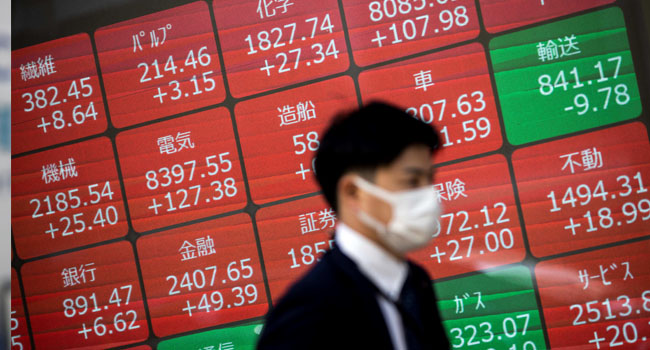
Asian stock markets surged on Wednesday following record highs on Wall Street, driven by strong earnings reports, renewed enthusiasm for technology stocks and expectations of progress in reopening the Strait of Hormuz.
The rally came as investors welcomed further evidence of continued artificial intelligence (AI) investment, while easing concerns over energy supply disruptions helped push oil prices and bond yields lower.
Japan’s Nikkei index jumped 3.5 per cent, supported by strong technology sector performance and increased spending on AI infrastructure.
South Korea’s stock market also extended its recent volatility, rising 4.3 per cent.
MSCI’s broadest index of Asia-Pacific shares outside Japan gained 2.3 per cent, while Chinese blue-chip stocks advanced 1.5 per cent.
The technology rally continued despite pressure on some major companies.
Advanced Micro Devices (AMD) shares fell 8.8 per cent in after-hours trading after its earnings exceeded expectations but failed to meet investors’ high projections.
AI and satellite company SpaceX also declined 7.5 per cent after investors raised concerns that its aggressive capital spending programme was affecting cash flow.
The concerns reflect a broader challenge facing AI-focused companies, as the rising cost of computing power continues to increase borrowing needs across the sector.
Chris Weston, head of research at broker Pepperstone, said SpaceX’s operational performance remained strong but warned that its investment strategy could require additional funding over the medium to long term.
He said how the company finances its expansion and the cost of doing so would remain a major focus for investors.
Investor attention is also turning to Thursday, when about 912 million SpaceX shares held by employees and other pre-IPO investors become eligible for sale.
Despite the mixed technology results, broader market sentiment remained positive.
Nasdaq futures were flat following the earnings reports, while S&P 500 futures gained 0.3 per cent after the index reached an all-time high on Tuesday.
European markets also showed strength, with EUROSTOXX 50 futures rising 0.3 per cent, DAX futures gaining 0.5 per cent and FTSE futures increasing 0.2 per cent.
Markets were supported by falling oil prices after Qatar said mediators were making progress in efforts to resolve tensions between the United States and Iran.
Brent crude dropped 0.6 per cent to $78.85 per barrel, while US crude declined 0.9 per cent to $75.09 per barrel.
John Oh, an energy economist at Commonwealth Bank of Australia, said shipping data suggested oil flows through the Strait of Hormuz had remained stronger than initially expected.
He estimated that oil traffic through the waterway may have reached 40 to 45 per cent of pre-war levels in the previous week.
Oh said oil markets could move into oversupply if flows recovered to between 50 and 60 per cent of pre-war levels, explaining why Brent prices quickly returned to the $70 range amid hopes of reopening the strait.
The decline in oil prices eased inflation concerns and supported global bond markets.
The yield on 10-year US Treasury bonds fell to 4.603 per cent from last week’s high of 4.747 per cent.
Markets also reduced expectations of a September interest rate increase by the US Federal Reserve, lowering the probability from 67 per cent to 57 per cent.
However, Kansas City Federal Reserve President Jeff Schmid called for tighter monetary policy to bring inflation back toward the central bank’s two per cent target.
Currency markets remained mostly stable, although the New Zealand dollar fell 0.3 per cent after data showed unemployment reached a decade-high of 5.6 per cent in the June quarter.
The euro traded flat at $1.1537, while the US dollar edged lower against the Japanese yen to 157.63.
Investors continued to monitor possible currency intervention after US Treasury Secretary Scott Bessent said he believed Bank of Japan Governor Kazuo Ueda would take measures that best support Japan’s economy.
Japan and the United States conducted a rare joint yen-buying intervention last week and indicated they could take further action if necessary.
In commodity markets, gold prices benefited from falling yields, rising 1.6 per cent to $4,140 per ounce.