Asian share markets climbed on Monday, following Wall Street higher after a weaker-than-expected US jobs report reduced expectations of a near-term increase in borrowing costs.
The gains came as investors assessed the outlook for US interest rates, while oil prices edged higher amid limited progress towards restoring normal shipping through the Strait of Hormuz.
Iran said on Sunday that an agreement with Oman to establish new shipping lanes through the strategic waterway was in its final stages.
However, Tehran reiterated that the strait would only reopen after the United States met additional conditions, keeping uncertainty around global energy supplies elevated.
Brent crude rose 0.6 per cent to $84.04 a barrel, while US West Texas Intermediate crude gained 0.5 per cent to $78.56.
Shipping through the Strait of Hormuz has remained at significantly reduced levels, supporting oil prices as markets assess the potential duration of the disruption.
The latest increase in fuel prices has also heightened attention on the US July consumer price report due on Wednesday.
Analysts are expecting headline consumer inflation to rise 0.1 per cent, while core inflation is forecast to increase 0.2 per cent.
A stronger-than-expected reading could revive expectations of a Federal Reserve interest-rate increase at its September meeting.
JPMorgan chief US economist Michael Feroli said a core CPI reading of around 0.22 per cent would probably not be sufficient to trigger a September rate hike, although repeated readings closer to 0.3 per cent could change the outlook.
Investors are also watching for a possible rebound in core goods prices following two consecutive months of declines.
Futures markets have reduced the probability of a September rate increase to about 45 per cent, down from 67 per cent a week earlier.
The decline in rate-hike expectations helped US Treasury bonds rally on Friday and supported Wall Street, which closed at record highs.
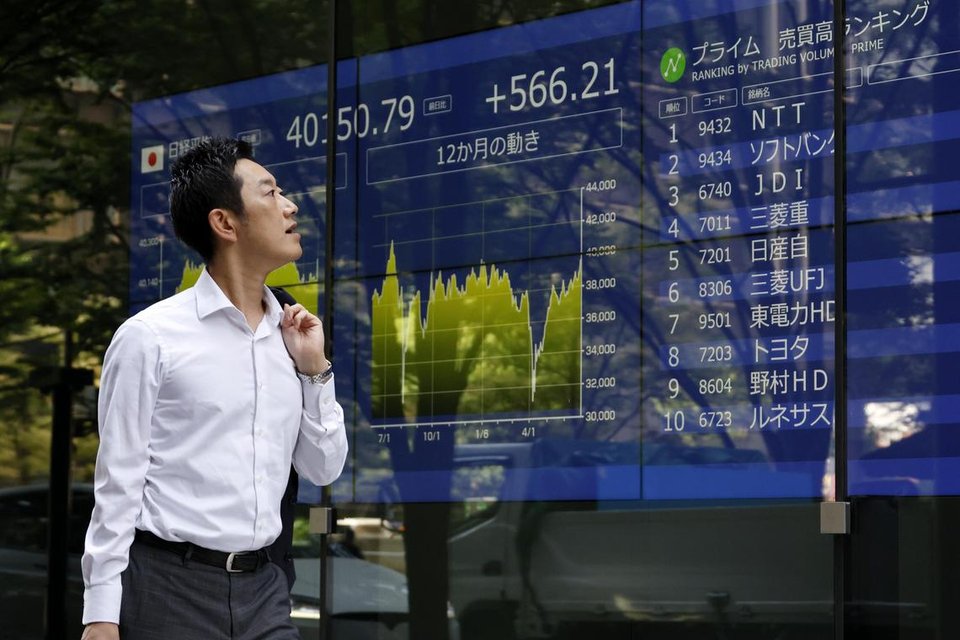
Asian markets followed the positive lead, with Japan’s Nikkei rising 2.0 per cent and South Korea’s benchmark gaining 0.8 per cent.
MSCI’s broadest index of Asia-Pacific shares outside Japan advanced 0.7 per cent.
Chinese blue-chip stocks, however, fell 0.7 per cent after data showed consumer and producer inflation came in below expectations in July, highlighting continued weakness in domestic demand.
European markets were more subdued, with EUROSTOXX 50 and DAX futures flat, while FTSE futures declined 0.4 per cent.
US futures remained positive, with S&P 500 futures up 0.1 per cent and Nasdaq futures gaining 0.3 per cent.
The Nasdaq had risen 5 per cent last week following a series of strong corporate earnings reports.
Bank of America analysts said nearly 90 per cent of S&P 500 companies had reported results, with earnings per share up 30 per cent year-on-year after excluding investment gains at Alphabet and Amazon.
The 76 per cent earnings-per-share beat rate matched the strongest level recorded since 2021, according to the analysts.
Artificial intelligence remained a key driver of corporate earnings, with median EPS growth of 28 per cent among AI-related companies compared with 12 per cent for companies outside the sector.
However, analysts expect AI-related earnings growth to slow to 16 per cent next quarter.
JPMorgan raised its 2026 S&P 500 earnings-per-share forecast to $365, representing annual growth of 35 per cent, and increased its S&P 500 price target to 8,000 from 7,800.
Investors are now turning their attention to a lighter earnings calendar this week, which includes results from semiconductor manufacturer Applied Materials, networking equipment maker Cisco and cloud infrastructure company CoreWeave.
In bond markets, the yield on the 10-year US Treasury edged higher to 4.662 per cent as investors prepared for $125 billion in new government debt issuance during the week.
The decline in yields and broader improvement in risk sentiment also weighed on the US dollar.
The euro remained close to a seven-week high at $1.1553, while the dollar gained 0.3 per cent against the Japanese yen to 158.35.
Investors remained cautious about the possibility of Japanese authorities intervening in currency markets if the yen weakens significantly.
Meanwhile, Bank of Japan policymakers warned of rising inflation risks that could require a faster-than-expected pace of interest-rate increases.
The warning strengthened expectations of a possible rate hike by the central bank in September.
In commodity markets, gold held around $4,333 an ounce after rising more than 7 per cent last week.
The decline in bond yields has supported demand for the non-interest-bearing metal as investors assess the outlook for US monetary policy and global economic risks.