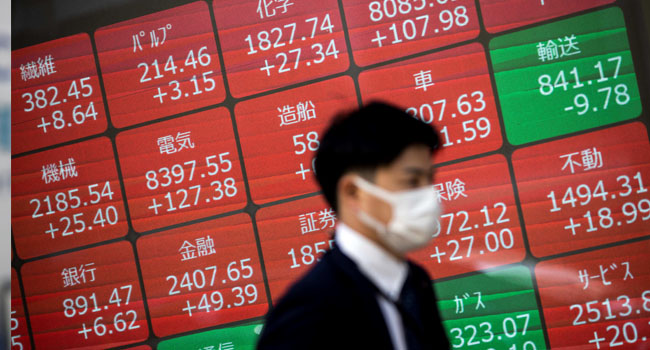
Asian equities declined on Thursday as investor enthusiasm over artificial intelligence (AI) spending weakened following the previous day’s rally, while oil markets remained range-bound amid ongoing assessments of a possible Iran peace agreement.
MSCI’s broadest index of Asia-Pacific shares outside Japan fell 1.39%, led by losses in technology stocks.
South Korean shares extended their decline, dropping 4.16%, while Japan’s Nikkei index fell 0.94% after earlier losses of as much as 2.05%.
In Seoul, Samsung Electronics dropped 6%, while chipmaker SK Hynix plunged nearly 10%. In Tokyo, Kioxia declined 8.2%, and semiconductor equipment maker Tokyo Electron fell 5.18%.
The sell-off followed a weaker session on Wall Street, where the Nasdaq ended a multi-day winning streak after disappointing investor reactions to quarterly earnings from SpaceX and Advanced Micro Devices (AMD).
SpaceX highlighted faster-than-expected returns from its AI investments, but investors remained concerned about the sustainability of its Starlink business as a funding source for expensive data centre expansion.
AMD’s earnings exceeded analysts’ forecasts but failed to meet the market’s high expectations, triggering renewed caution among investors over the pace and profitability of AI-related spending.
Meanwhile, oil prices remained under pressure as markets monitored developments around a potential agreement between Iran and the United States.
A senior Iranian source and two regional officials told Reuters that a proposed deal involving Iran and Oman could help end a five-month conflict between Tehran and Washington. The agreement would reportedly allow Iran to maintain control over ships entering the Gulf through the Strait of Hormuz, representing a major concession in negotiations.
Brent crude futures declined 0.55% to $79.01 per barrel, while US West Texas Intermediate (WTI) futures fell 0.65% to $74.73 per barrel.
Madison Cartwright, senior geo-economics analyst at Commonwealth Bank of Australia, said a deal to reopen the Strait of Hormuz could be reached by early September, although he remained sceptical that an agreement was close.
“Iran still has more leverage and will extract additional concessions from the U.S. under any new deal,” Cartwright said.
US stocks ended mixed on Wednesday, with the Dow Jones Industrial Average gaining about 0.5% to record another closing high.
European markets opened slightly higher, with Euro Stoxx 50 futures rising 0.18%, German DAX futures gaining 0.26%, and FTSE futures increasing 0.06%.
Investors are now focused on US labour market data ahead of Friday’s closely watched nonfarm payrolls report.
Data released on Wednesday showed private employers added 44,000 jobs last month, down from 95,000 in June and below economists’ expectations by about 25,000 jobs.
Economists surveyed by Reuters expect the US economy to have added 80,000 jobs in July, compared with 57,000 in June, while the unemployment rate is projected to remain unchanged at 4.2%.
Market expectations for a Federal Reserve interest rate hike at the September meeting eased slightly, with futures markets pricing in a 54% probability, down from 58% a day earlier, according to the CME FedWatch tool.
Federal Reserve Bank of San Francisco President Mary Daly said she fully supported last week’s decision by policymakers to keep interest rates unchanged.
The benchmark US 10-year Treasury yield fell 0.83 basis points to 4.609%.
In currency markets, the dollar remained steady against the yen at 157.75 following Japan and the United States’ recent intervention to support the Japanese currency.
Sony Financial Group senior analyst Juntaro Morimoto said the dollar-yen pair is likely to lack a clear direction as investors remain cautious ahead of Friday’s US jobs report.
Gold prices continued their upward trend, with spot gold rising 0.2% to $4,254.10 per ounce, marking a fourth consecutive session of gains.
Spot silver, however, declined 0.38% to $61.84 per ounce.