British International Investment (BII), the United Kingdom’s development finance institution, has committed $7 million in debt financing to Okra Solar to accelerate access to reliable and clean electricity in rural communities across Nigeria.
The financing is expected to support the procurement of equipment for approximately 150,000 new solar-powered connections, with the potential to provide electricity to as many as 750,000 people who currently have limited or no access to reliable power supply.
The investment, announced on November 10, 2026, represents another development in efforts to address Nigeria’s electricity access challenges through renewable energy and privately driven power infrastructure.
According to information released by BII, the funding will enable Okra Solar to purchase solar photovoltaic equipment, batteries and other essential components in larger quantities and ahead of project implementation.
This approach is expected to reduce procurement delays and improve the company’s ability to deliver electricity infrastructure to communities that need it.
Okra Solar explained that the financing would change its procurement model by allowing it to purchase essential equipment before individual project agreements are completed.
Previously, the company generally waited for project transactions to close before ordering equipment in relatively small batches.
With the new financing arrangement, delivery times for equipment to Nigeria are expected to reduce from approximately four months to two months.
The development could improve project execution and allow electricity connections to be delivered more quickly.
Funding targets underserved communities
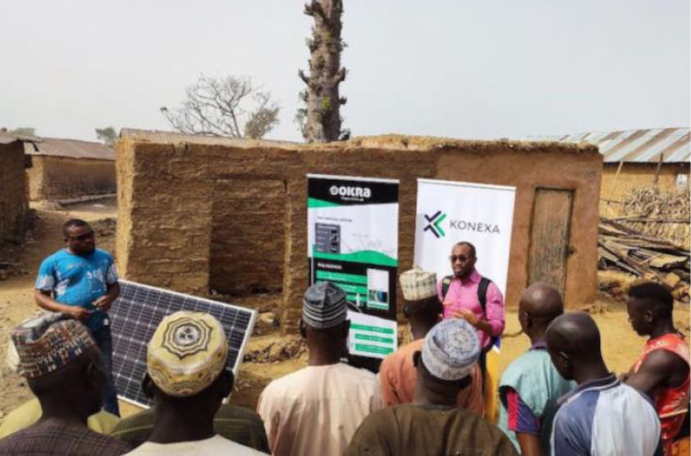
Okra Solar provides mesh-grid technology designed to supply electricity to communities that are not adequately served by conventional electricity networks.
Its system combines solar generation, battery storage and smart controls, allowing neighbouring households and businesses to share electricity.
The approach is particularly relevant to rural communities where extending the national electricity grid may be expensive or difficult.
According to the company’s reported figures, it currently serves more than 13,000 connected households and has over 2.3 megawatts of installed capacity.
The proposed 150,000 additional connections would therefore represent a significant expansion of its existing operations.
BII said the investment would help accelerate access to reliable and clean electricity, particularly in communities where households and small businesses depend heavily on expensive and less environmentally friendly energy sources.
The importance of the investment can also be seen in the experiences of small business owners who spend considerable amounts operating petrol generators.
BII cited the example of a phone-charging business owner in Nasarawa State who previously spent approximately ₦60,000 weekly on petrol for a generator.
Following connection to an Okra-powered mesh-grid system, the business owner’s reported weekly electricity expenditure dropped to approximately ₦6,000.
This represents a substantial reduction in operating costs and demonstrates how alternative energy solutions could improve the financial position of small businesses.
Renewable energy investment gains attention
Nigeria continues to face challenges associated with inadequate electricity supply, particularly in rural and underserved communities.
Unreliable electricity increases operating costs for businesses, affects productivity and limits opportunities for economic development.
Renewable energy providers have increasingly explored alternative electricity distribution models to address these challenges.
The Nigerian government’s Distributed Access through Renewable Energy Scale-up programme, supported by the World Bank, is among the initiatives designed to increase electricity access through decentralised renewable energy solutions.
Okra Solar’s financing arrangement could complement these efforts by helping private energy developers access equipment and infrastructure needed to expand their operations.
BII described the investment as climate financing, reflecting its focus on supporting businesses that contribute to cleaner energy generation and improved electricity access.
The investment also falls under the 2X Challenge, an initiative supporting women’s economic empowerment through private-sector investment.
Implications for Nigeria’s economy
The $7 million facility could have implications beyond electricity access.
Reliable electricity can help small businesses reduce operating expenses, extend working hours, improve service delivery and invest in expansion.
For rural communities, access to electricity can also support healthcare facilities, educational institutions, communication services and other essential activities.
However, the actual impact will depend on how quickly the company deploys the equipment, completes projects and connects households to the electricity systems.
The financing also highlights the importance of private investment in addressing Nigeria’s infrastructure gaps.
As the country continues to pursue broader electricity access, partnerships involving development finance institutions and renewable energy companies could play an important role in supporting the transition.
For Okra Solar, the funding provides an opportunity to increase its operational capacity and reach more communities.
For Nigeria, the development represents another effort to expand electricity access through cleaner and potentially more affordable energy solutions.