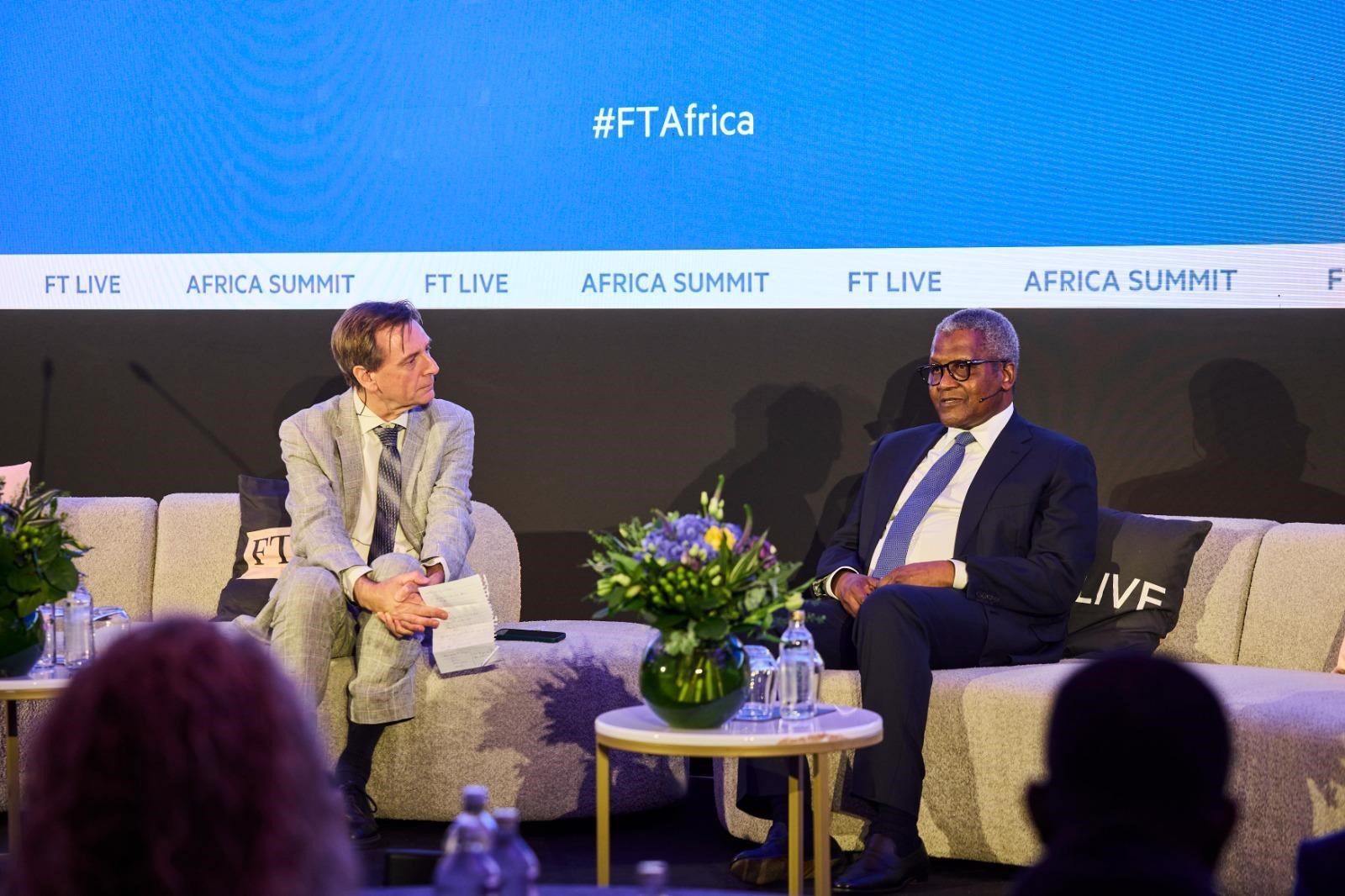
President and Chief Executive of Dangote Industries Limited, Aliko Dangote, has unveiled plans to expand the group’s petroleum distribution network across Africa, with investments in pipelines, storage facilities and strategic supply corridors aimed at improving access to refined petroleum products across the continent.
Dangote also called on African governments to protect domestic industries against unfair foreign competition, arguing that dependence on imported goods undermines local manufacturing, destroys employment opportunities and limits the continent’s capacity to build sustainable economies.
Speaking during a conversation with Financial Times journalist David Pilling, the industrialist disclosed that the group had acquired a 25 per cent stake in a petroleum products pipeline network in Kenya and was pursuing additional distribution projects involving Ethiopia, Cameroon and Namibia.
He said the expansion would connect the Dangote Petroleum Refinery in Lagos with markets across East, Central and Southern Africa, helping to address supply constraints and reduce the logistical challenges associated with transporting petroleum products over long distances.
Dangote said the group was pursuing the strategy aggressively as part of a broader effort to develop an integrated African energy supply network.
“We are very aggressive with that,” he said, discussing plans to establish depots, pipelines and other distribution infrastructure across the continent.
Dangote secures 25% stake in Kenyan pipeline network
The industrialist disclosed that the group had acquired a 25 per cent interest in Kenya’s petroleum products pipeline network, describing the investment as a strategic step towards expanding its presence in East Africa.
According to Dangote, the transaction received support from the Kenyan president and would strengthen the group’s ability to distribute refined products in the region.
He also outlined plans for a distribution corridor linking Djibouti to Addis Ababa, Ethiopia’s capital, with tank farms expected to support the storage and movement of petroleum products.
In Central Africa, he said a project in Cameroon was approaching completion, while Namibia had emerged as a strategic location for expanding the group’s reach into Southern Africa.
Dangote said the distance between Lagos and Namibia offered an opportunity to establish a relatively efficient maritime supply route from the refinery.
“From our refinery to Namibia is just about four days of steaming,” he said.
Under the proposed arrangement, refined products would be shipped from Lagos to Namibia and distributed into neighbouring markets, including Botswana and South Africa.
The group is also considering a wider distribution corridor extending through Zimbabwe and Zambia, with strategically positioned storage and transportation facilities intended to serve several countries.
The planned network would expand the commercial reach of the Dangote Petroleum Refinery while creating additional routes for supplying markets that have traditionally relied on imported petroleum products and fragmented distribution systems.
Proposed 700,000-barrel refinery in Kenya
Beyond distribution infrastructure, Dangote discussed plans to establish a refinery in Lamu, Kenya, with a proposed processing capacity of approximately 700,000 barrels per day.
He said the investment was informed by East Africa’s industrial and mining activities, rising energy requirements and difficulties in obtaining reliable supplies of diesel and other petroleum products.
According to him, the proposed refinery would source crude oil from multiple markets rather than depend exclusively on supplies from Kenya or Uganda.
Dangote said the selection of Lamu followed technical assessments of several possible locations, with access to deep water, marine facilities and adequate water resources among the considerations that informed the decision.
He added that the investment decision was reached within four months but alleged that commercial interests had attempted to frustrate the project through legal proceedings shortly before its public unveiling.
The proposed refinery and the distribution network form part of the group’s wider effort to expand its industrial footprint beyond Nigeria and strengthen links between African energy markets.
The project’s eventual implementation will depend on financing, approvals, infrastructure development and other execution requirements.
Dangote warns against dependence on imported products
Beyond petroleum infrastructure, Dangote argued that African countries must adopt policies that support domestic manufacturing and protect productive capacity from unfair external competition.
He maintained that the continent could not achieve broad-based industrial development if local manufacturers were unable to compete with imported goods in their home markets.
According to him, allowing imports to displace locally manufactured products results in jobs and economic opportunities being transferred outside Africa.
“Exporting our jobs out of the continent, importing poverty into the continent,” he said, describing the consequences of excessive dependence on foreign products.
Dangote questioned why African governments should expose emerging industries to unrestricted competition when established economies were increasingly adopting measures to support their own manufacturers.
“If America is now saying, no, we are going to protect our industries, who are we in Africa not to protect our own industries?” he asked.
His position centres on the need for African governments to combine regional trade and economic integration with policies that enable domestic industries to grow.
The argument also raises the challenge of balancing industrial protection with competition, affordability and the objectives of regional free-trade arrangements. Measures to support local producers would need to be designed in ways that encourage productivity and investment while avoiding unnecessary barriers to legitimate intra-African commerce.
$50bn investment ambition for 2026–2030
Dangote disclosed that the group had budgeted approximately $50 billion for investments between 2026 and 2030.
He presented the investment programme as part of a wider ambition to demonstrate Africa’s capacity to develop and operate large-scale industrial projects, while encouraging other entrepreneurs and investors to participate in the continent’s economic transformation.
“The legacy we are trying to set up is how do we industrialise our continent?” he said.
The proposed investments reflect the group’s focus on energy, infrastructure and industrial development, although the disclosure did not provide a detailed breakdown of the planned expenditure by country or project.
Dangote said Africa’s transformation would require more than investment by individual companies, pointing to the importance of strong financial institutions, effective agricultural and industrial policies, and infrastructure capable of supporting production.
He argued that governments must create conditions that allow businesses to process raw materials locally, expand manufacturing and develop industries that can supply both domestic and regional markets.
Power shortages remain a major obstacle
Dangote identified unreliable electricity supply as one of the principal constraints on African industrialisation, particularly in mining and mineral processing.
He said inadequate power infrastructure makes it difficult for resource-rich countries to process minerals and other raw materials locally before exporting them, limiting the economic value retained within their economies.
The industrialist cited an estimate that approximately 650 million Africans lacked access to electricity, arguing that expanding reliable power supply would create opportunities for manufacturing, employment and economic diversification.
He said the continent’s agricultural resources, mineral wealth and youthful population provided a foundation for industrial growth, but that these advantages needed to be supported by infrastructure, investment and policies that encourage value addition.
For manufacturers, dependable electricity is critical to managing production costs, maintaining output and competing with imported products. Power shortages can also discourage investment in processing industries that require continuous and energy-intensive operations.
Dangote’s comments reinforce the connection between energy security and industrial development, with petroleum distribution, refining capacity and electricity infrastructure representing different parts of the continent’s broader economic challenge.
Regional trade and industrialisation
Dangote’s proposed distribution network highlights the commercial opportunities available from stronger energy links between African countries. However, the success of such a network will depend on the availability of storage facilities, transport infrastructure, reliable supply arrangements and supportive regulatory frameworks across participating markets.
His call for industrial protection also places the debate over African free trade in sharper focus: regional integration can expand markets for manufacturers, but local businesses must also be able to invest, improve productivity and compete on sustainable terms.
For Nigeria, the expansion could create additional export opportunities for refined petroleum products and strengthen the regional role of the Dangote Petroleum Refinery. For other African markets, new distribution routes could provide alternative supply channels, although the actual effect on prices and availability would depend on operating costs, market conditions and the execution of the projects.
Dangote expressed confidence that African governments and businesses were increasingly recognising the need to take greater responsibility for the continent’s industrial future.
“The journey has started,” he said. “But now we’re awake, and we will make it happen.”
The group’s planned investments and proposed cross-border projects will now be judged by their implementation, the scale of infrastructure delivered and their contribution to more reliable energy supplies and productive economic activity across Africa.