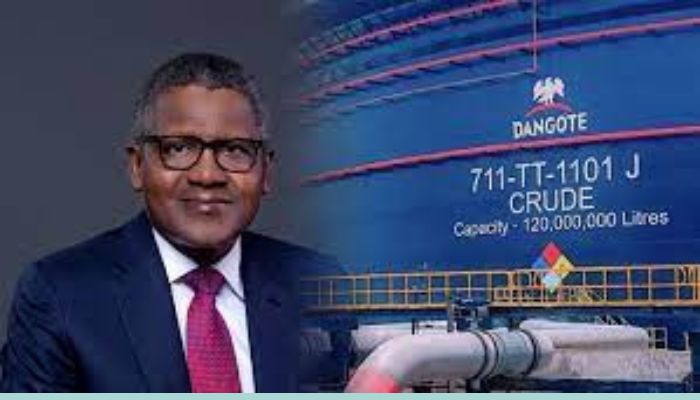
The Dangote Petroleum Refinery has sealed an offtake agreement with 12 leading petroleum marketing companies to distribute between 60 million and 65 million litres of Premium Motor Spirit (PMS), also known as petrol, daily across Nigeria.
The move is expected to stabilise supply and deepen the country’s fuel self-sufficiency.
President of the Dangote Group, Aliko Dangote, disclosed the development in Lagos. He said the structured framework would ensure nationwide availability of petrol, while surplus volumes would be exported.
“We have agreed an offtake framework to supply up to 65 million litres daily for the domestic market. Any surplus, estimated at between 15 and 20 million litres, will be exported,” Dangote said in a statement.
Nigeria’s daily petrol consumption currently ranges between 50 million and 60 million litres. This means the refinery could supply about 1.8 billion to over 2 billion litres monthly, depending on output and the number of days in a month.
The arrangement, endorsed by the Nigerian Midstream and Downstream Petroleum Regulatory Authority, assigns selected marketers to manage distribution nationwide. The goal is to prevent supply disruptions, curb hoarding, and eliminate speculative pricing practices.
The marketers involved include:
MRS Oil Nigeria Plc
Nigerian National Petroleum Company Limited Retail
11 Plc
TotalEnergies Marketing Nigeria
Rainoil Limited
Northwest Petroleum & Gas Company Limited
Ardova Plc
Bovas & Company Limited
AA Rano Nigeria Limited
AYM Shafa Limited
Conoil Plc
Masters Energy
The structured model is designed to improve logistics efficiency and support price stability in the deregulated downstream market.
The agreement follows an earlier deal in October 2025 between the refinery and downstream operators to release up to 600 million litres of PMS monthly to address supply disruptions and rising pump prices.
Dangote said exporting surplus volumes after meeting domestic demand would conserve foreign exchange and improve Nigeria’s trade balance. For decades, Africa’s largest oil producer relied heavily on imported refined products, exposing the economy to exchange rate volatility and global supply shocks.
The Group Chief Executive Officer of Nigerian National Petroleum Company Limited, Bayo Bashir Ojulari, recently described the refinery as a transformative national asset.
“This plant was designed for 650,000 barrels per day. None of us thought it would even touch 550,000. What we saw live today was 661,000. These are live parameters, not reports or photographs,” Ojulari said.
Nigeria has intensified reforms in the oil and gas sector following deregulation and the removal of fuel subsidy under Bola Tinubu.
The Dangote refinery, Africa’s largest, is expected to play a central role in ending decades of petrol importation, stabilising prices, and positioning Nigeria as a net exporter of refined petroleum products in West and Central Africa.
If successful, the structured offtake model could mark a turning point in Nigeria’s fuel supply chain and significantly reduce the risk of recurring shortages.