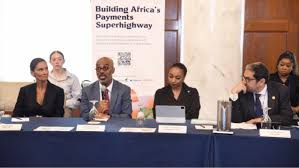
Flutterwave hosted a private Digital Economy Roundtable in partnership with Invest Africa on April 14, 2026, bringing together global investors, policymakers and technology leaders to discuss the future of Africa’s digital economy.
The roundtable was held on the sidelines of the IMF/World Bank Spring Meetings in Washington, D.C., and was moderated by Shannon Stround.
The session convened development finance institutions, global investors and policymakers to assess investment opportunities in Africa’s digital sector and the infrastructure required to scale it across borders.
Among the participants was Nigeria’s Minister of Industry, Trade and Investment, Jumoke Oduwole, who highlighted the improving investment climate in Nigeria’s digital economy.
Other prominent attendees included Haytham Elmaayergi, Wale Adeosun, Yvonne Ike, Bolaji Balogun and Miguel Azevedo.
Senior leaders from Flutterwave led discussions around three strategic pillars: scaling cross-border digital infrastructure, fintech integration and regulatory harmonisation, and mobilising investment capital for Africa’s digital economy.
Flutterwave’s Chief Legal, Regulatory and Public Policy Officer, Bankole Falade, opened the session with remarks on building Africa’s “payments superhighway.”
He traced the company’s decade-long journey of connecting fragmented payment systems across the continent through a unified platform.
“When Flutterwave started 10 years ago, the primary goal was to connect fragmented payment infrastructure across the continent. When businesses are able to make and receive payments, economies grow and businesses thrive,” Falade said.
“As we look forward to the next 10 years, what we want to do is connect Africa to the rest of the world, and the world to Africa, with seamless payment solutions.”
The conversation on mobilising investment capital was led by Bridgit Antwi, who discussed the need to support ecosystem consolidation and expand access to short-term liquidity solutions for businesses operating in Africa’s digital markets.
Meanwhile, Bolanle Baruwa highlighted the importance of scaling digital infrastructure and developing talent pipelines that align with the continent’s growing technology sector.
She noted that the payments superhighway could serve as a bridge for deploying global capital into Africa’s estimated $1.5 trillion digital economy.
Falade also advocated for “regulatory passporting,” a policy approach aimed at reducing cross-border entry costs and enabling fintech firms to scale more efficiently across African markets.
Participants at the roundtable agreed that Africa remains one of the most attractive long-term investment destinations globally, particularly in digital infrastructure, fintech and technology-enabled sectors.
They noted that macroeconomic reforms, regulatory improvements and policy modernisation in several African markets are strengthening the foundations for investment.
However, speakers emphasised that deeper regional integration and interoperable digital systems will be critical to unlocking larger cross-border markets.
The roundtable also drew representatives from organisations including Afreximbank, Bank of America, British International Investment, Chapel Hill Denham, Citibank, European Bank for Reconstruction and Development, Gates Foundation, Google, Nigerian Sovereign Investment Authority, U.S. International Development Finance Corporation, World Bank Group and Nigerian Exchange Group.
Participants concluded that investor sentiment toward Africa is shifting, with growing emphasis on execution and scalable platforms capable of delivering long-term value across the continent’s digital economy.