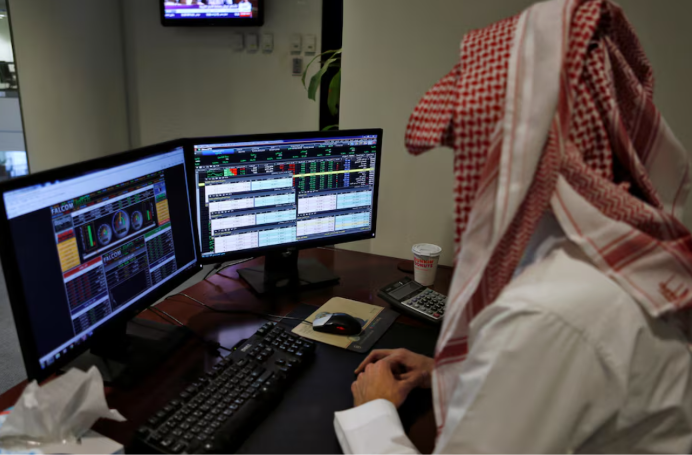
Stock markets across several Gulf countries declined on Sunday, November 15, 2026, as escalating tensions in the Middle East increased concerns among investors about regional security, energy supplies and the outlook for international trade.
The decline followed reports of attacks involving oil tankers and increasing military tensions across the region, raising fears that disruptions to important energy transportation routes could continue.
According to Reuters, Saudi Arabia’s benchmark stock index fell by 0.7 per cent during Sunday’s trading session, while Qatar’s main stock market index recorded a larger decline of 1.8 per cent.
The losses reflected growing uncertainty among investors as developments around the Strait of Hormuz continued to threaten international shipping and energy transportation.
The Strait of Hormuz is one of the world’s most important maritime routes for crude oil and liquefied natural gas shipments.
Any prolonged disruption to the waterway could affect the movement of energy products between major producing and consuming countries.
The situation is particularly important to Gulf economies because several countries in the region depend heavily on energy exports, international trade and foreign investment.
For financial markets, increasing geopolitical uncertainty can influence investor confidence, company valuations and expectations about future economic performance.
Saudi Arabia’s stock market records losses
Saudi Arabia’s benchmark stock index declined by 0.7 per cent as investors reacted to the latest security developments in the region.
Shares of Saudi National Bank, one of the country’s major financial institutions, fell by 2.3 per cent during the session.
The banking sector plays an important role in Saudi Arabia’s economy because financial institutions provide loans, payment services and investment financing to businesses and individuals.
Banks also support government-backed development projects and private-sector activities.
A decline in major banking stocks can therefore influence the overall performance of the stock market.
Investor concerns surrounding the regional security situation may also affect companies operating in industries that depend on stable transportation, tourism, energy supplies and international business relationships.
The Saudi market’s decline came amid reports of increasing Houthi attacks on Saudi airports, ports and energy facilities.
The Saudi-led coalition said it had intercepted two ballistic missiles aimed at Riyadh and three drones over the Eastern Province.
These developments increased concerns about the security of important economic facilities and transportation infrastructure.
Qatar’s stock market experiences a sharper decline
Qatar’s benchmark stock index recorded a larger decline than Saudi Arabia’s, falling by 1.8 per cent during Sunday’s trading session.
Reuters reported that every constituent of the Qatari index declined, indicating widespread selling pressure across the market.
Qatar National Bank, one of the country’s major financial institutions, lost 2.3 per cent.
The performance reflected concerns about the potential economic consequences of continuing regional instability.
Qatar is an important international supplier of liquefied natural gas, and its energy sector plays a major role in the country’s economy.
LNG is natural gas that has been cooled into liquid form to make it easier to transport over long distances by specialised vessels.
Countries that import LNG use it for electricity generation, industrial production and other energy requirements.
Any disruption to Qatar’s export operations can therefore affect international energy markets and the companies that depend on reliable gas supplies.
Tanker attacks increase concerns over shipping routes
One of the major developments affecting investor sentiment was the report of attacks on oil tankers in the region.
Iran’s navy said a mine strike on Saturday had set three oil tankers ablaze.
The incident raised further concerns about the safety of commercial vessels operating around important energy transportation routes.
Shipping companies play an essential role in international trade by transporting crude oil, refined petroleum products, natural gas and other commodities between countries.
When security risks increase, companies may face higher insurance costs, additional security requirements and delays in transporting goods.
Some vessels may also need to reconsider their routes depending on the security situation.
These challenges can increase operating expenses and affect the profitability of shipping businesses.
For energy companies, disruptions to tanker movements could delay export deliveries and affect contractual arrangements with international customers.
The Strait of Hormuz remains particularly important because of the large volumes of oil and gas that move through the waterway.
Any prolonged disruption could create additional pressure on global energy supplies and increase uncertainty in international commodity markets.
Qatar’s LNG exports face continuing difficulties
Qatar’s energy industry has been severely affected by the conflict involving Iran.
Reuters reported that an Iranian attack in March had disrupted the country’s LNG export operations and prompted force majeure on deliveries.
Force majeure is a contractual provision that allows a party to suspend or avoid certain obligations when extraordinary circumstances beyond its control prevent it from fulfilling an agreement.
The report also highlighted the cancellation of a long-standing Gulf LNG contract on force majeure grounds for the first time since the conflict began.
The development has implications for international energy companies and countries that depend on long-term LNG supply agreements.
Long-term contracts are important in the energy industry because they help producers and buyers plan production, transportation and consumption over several years.
When these arrangements are disrupted, buyers may need to find alternative suppliers or purchase energy through other market arrangements.
Reuters reported that Poland’s Orlen could save up to $2 billion following the cancellation of the affected contract.
The situation demonstrates how geopolitical developments can create financial consequences for companies operating far beyond the immediate conflict zone.
Egypt records a different market performance
While Saudi Arabia and Qatar experienced losses, Egypt’s blue-chip stock index recorded a different performance.
According to Reuters, Egypt’s benchmark index increased by 0.3 per cent during Sunday’s session.
The difference in performance highlights how individual markets can react differently to regional developments.
Domestic economic conditions, investor positioning, company earnings and exposure to international energy markets can influence the performance of individual stock exchanges.
Although geopolitical tensions affected sentiment across several Gulf markets, the impact was not identical across the wider Middle East.
This shows why investors often assess individual markets and companies rather than treating the entire region as one financial market.
Implications for international investors
The latest market declines highlight the sensitivity of financial markets to geopolitical developments.
For international investors, continuing uncertainty in the Middle East creates additional risks when evaluating companies operating in energy, banking, aviation, shipping and other sectors.
Oil and gas businesses could experience disruptions to production and transportation, while shipping companies may face higher insurance and operating costs.
Banks may also experience uncertainty if businesses and consumers face increased financial pressure from higher energy prices and weaker economic activity.
Countries that depend heavily on international trade could face higher import costs if shipping routes become more expensive or difficult to access.
These developments can also affect inflation because higher transportation and energy costs may eventually be passed on to businesses and consumers.
Possible effects on Nigeria’s business environment
Nigeria could also experience indirect effects from developments in the Gulf region.
As a crude oil-exporting country, Nigeria’s government revenue and foreign exchange earnings are influenced by international oil prices and export volumes.
An increase in crude oil prices could improve potential earnings for oil producers, provided production and export operations remain stable.
However, higher international oil prices may also create additional pressure on energy-importing businesses and consumers.
Shipping costs and insurance expenses can affect the movement of goods between countries, including products imported into Nigeria.
For Nigerian businesses involved in manufacturing, aviation, transportation and international trade, changes in global energy prices can influence operating expenses.
The broader economic impact will depend on how long the regional tensions continue and whether international shipping operations return to normal.
Investors await further developments
The decline in Saudi and Qatari equities reflects growing caution among investors as regional security concerns continue to affect financial markets.
The performance of Gulf stock exchanges in subsequent sessions will depend partly on developments involving the Strait of Hormuz, tanker security and energy infrastructure.
Investors will also monitor government responses, international diplomatic efforts and the ability of energy companies to maintain production and export operations.
For now, the market reaction demonstrates that geopolitical developments can have immediate financial consequences, even for businesses that are not directly involved in the conflict.