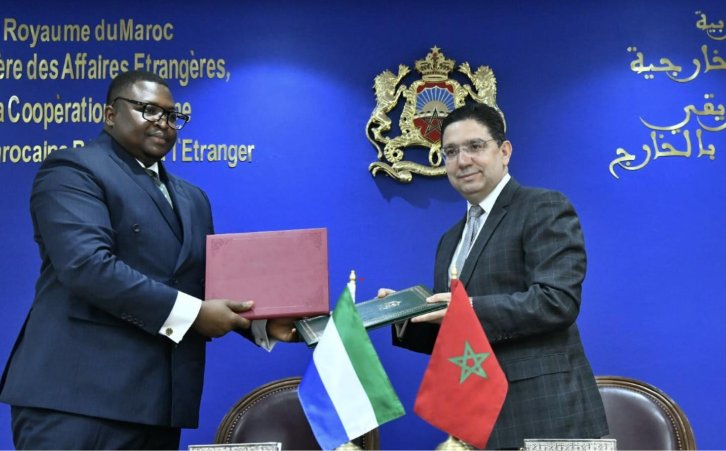
Morocco and Sierra Leone have signed a three-year economic cooperation roadmap aimed at strengthening bilateral relations and expanding collaboration in key sectors of their economies.
The agreement, which covers the 2027 to 2029 period, was signed on November 10, 2026, in Rabat, Morocco, by Sierra Leone’s Minister of Foreign Affairs and International Cooperation, Mohamed Rahman Swaray, and Morocco’s Minister of Foreign Affairs, African Cooperation and Moroccans Living Abroad, Nasser Bourita.
The agreement is expected to provide a framework for both countries to expand cooperation in agriculture, mining, fisheries, water management, trade and investment.
The development reflects growing efforts by African countries to strengthen economic partnerships within the continent and create opportunities for trade, industrial development and investment.
According to a statement released by the Sierra Leone Embassy in Morocco, the two ministers reviewed existing bilateral relations and discussed ways to translate previous agreements into practical development programmes.
Both countries expressed their commitment to strengthening their relationship and improving cooperation in areas considered important to their economic development.
Agriculture is among the key sectors identified in the roadmap. The sector remains important to many African economies because of its contribution to employment, food production and rural development.
Stronger agricultural cooperation could provide opportunities for technical exchanges, investment and the development of more productive farming systems.
Mining is another major area of interest under the agreement.
Both countries possess mineral resources that play important roles in their economies. Cooperation in this sector could create opportunities for investment, technical knowledge exchange and improved management of natural resources.
The roadmap also identifies fisheries and the blue economy as priority areas.
These sectors are particularly relevant because both countries have access to the Atlantic Ocean and opportunities to develop marine resources, coastal businesses and related industries.
Water management is another important component of the agreement.
Improved cooperation in water infrastructure and management could support agriculture, communities and other economic activities that depend on reliable water supplies.
The ministers also discussed trade, investment and fertiliser supplies as part of their broader economic discussions.
According to the embassy statement, the two countries agreed to convene the fourth session of their Joint Commission for Cooperation in 2027.
The meeting is expected to provide an opportunity to review progress and identify practical projects that can support the implementation of the roadmap.
Sierra Leone also highlighted the importance of regional integration and infrastructure development during the discussions.
The country’s foreign affairs minister referred to the proposed African Atlantic Gas Pipeline as an example of cooperation that could strengthen regional connectivity, increase trade opportunities and reduce Africa’s exposure to fluctuations in international markets.
The pipeline project is intended to connect natural gas resources and markets across several West African countries, although its wider implementation will depend on financing, agreements and infrastructure development.
Morocco has increasingly pursued partnerships with African countries through diplomatic, commercial and investment initiatives.
For Sierra Leone, stronger relations with Morocco could provide opportunities to attract investment and improve cooperation in sectors that support economic growth.
However, the success of the three-year roadmap will depend on how effectively both governments translate their commitments into projects, financing arrangements and measurable outcomes.
Signing an agreement alone does not guarantee increased trade or investment. Both countries will need to establish implementation mechanisms and maintain regular engagement.
The 2027–2029 roadmap therefore represents an important framework for strengthening relations between the two countries.
If effectively implemented, it could contribute to broader African economic cooperation and create opportunities for businesses operating in agriculture, mining, fisheries and other priority sectors.