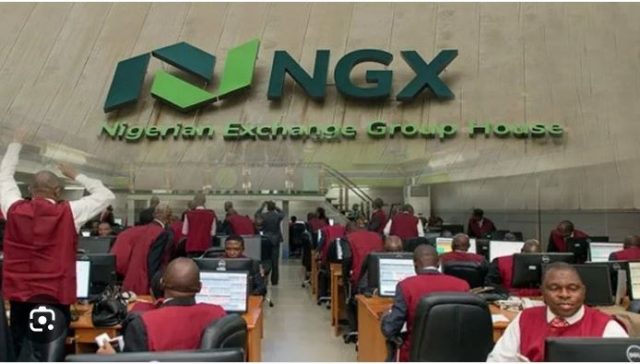
The Nigerian equities market opened the week on a strong note on Monday, with the benchmark NGX All-Share Index (ASI) rising 1.21% to a fresh record high of 248,529.75 points as renewed buying interest lifted total market capitalisation by N1.91 trillion to N160.42 trillion.
The latest rally pushed the market’s year-to-date return to 59.71%, extending the strong gains recorded by equities investors since the beginning of 2026.
According to the Nigerian Exchange Limited’s Daily Official List, the ASI closed at 248,529.75 points, compared with 245,573.60 points recorded at the previous trading session. The index also recorded an intraday high of 248,529.75 points, while its five-day average stood at 245,805.55 points.
Despite the strong performance of the benchmark index, market breadth remained negative, indicating that the rally was driven largely by gains in selected heavyweight stocks rather than broad-based buying.
A total of 36 stocks declined during the session, compared with 23 gainers, resulting in a market breadth of 0.6x.
Among the major decliners were AVACAP, Ecobank Transnational Incorporated, Caverton Offshore Support Group, Ikeja Hotel and FTN Cocoa Processors.
On the other hand, Fidson Healthcare, Chams Holding Company, NAHCO, Airtel Africa and Sovereign Trust Insurance recorded notable gains.
The divergence between the index performance and market breadth points to continued profit-taking pressure, even as the broader market maintains its bullish trajectory.
Sectoral performance was also mixed. The Consumer Goods Index emerged as the strongest positive contributor, gaining 0.76% during the session.
The gains in the consumer goods sector were offset by declines across most other major sectors. The Insurance Index fell 1.64%, while the Banking Index declined 0.24%.
The Oil and Gas Index shed 0.09%, while the Industrial Goods Index eased 0.05%. The Commodity sector closed flat.
The mixed sector performance highlights the selective nature of investor positioning, with buying interest concentrated in specific stocks rather than spread evenly across the market.
Trading activity increased in some areas, with investors executing 59,185 deals, representing a 39% rise from the previous session.
Trading volume also increased by 1.37% to 1.14 billion shares, pointing to stronger participation among market investors.
However, total turnover moved in the opposite direction, falling 25.11% to N27.02 billion. The decline suggests that a greater proportion of trading activity was concentrated in lower-priced stocks.
The latest performance further consolidates the Nigerian equities market’s remarkable run in 2026 and pushes the ASI deeper above the 245,000-point level.
With the benchmark index now up 59.71% year-to-date, Nigerian equities remain among the strongest-performing asset classes for domestic investors.
However, the widening gap between the number of declining and advancing stocks suggests that profit-taking could play a greater role in short-term market movements as investors reassess positions following the market’s substantial gains.