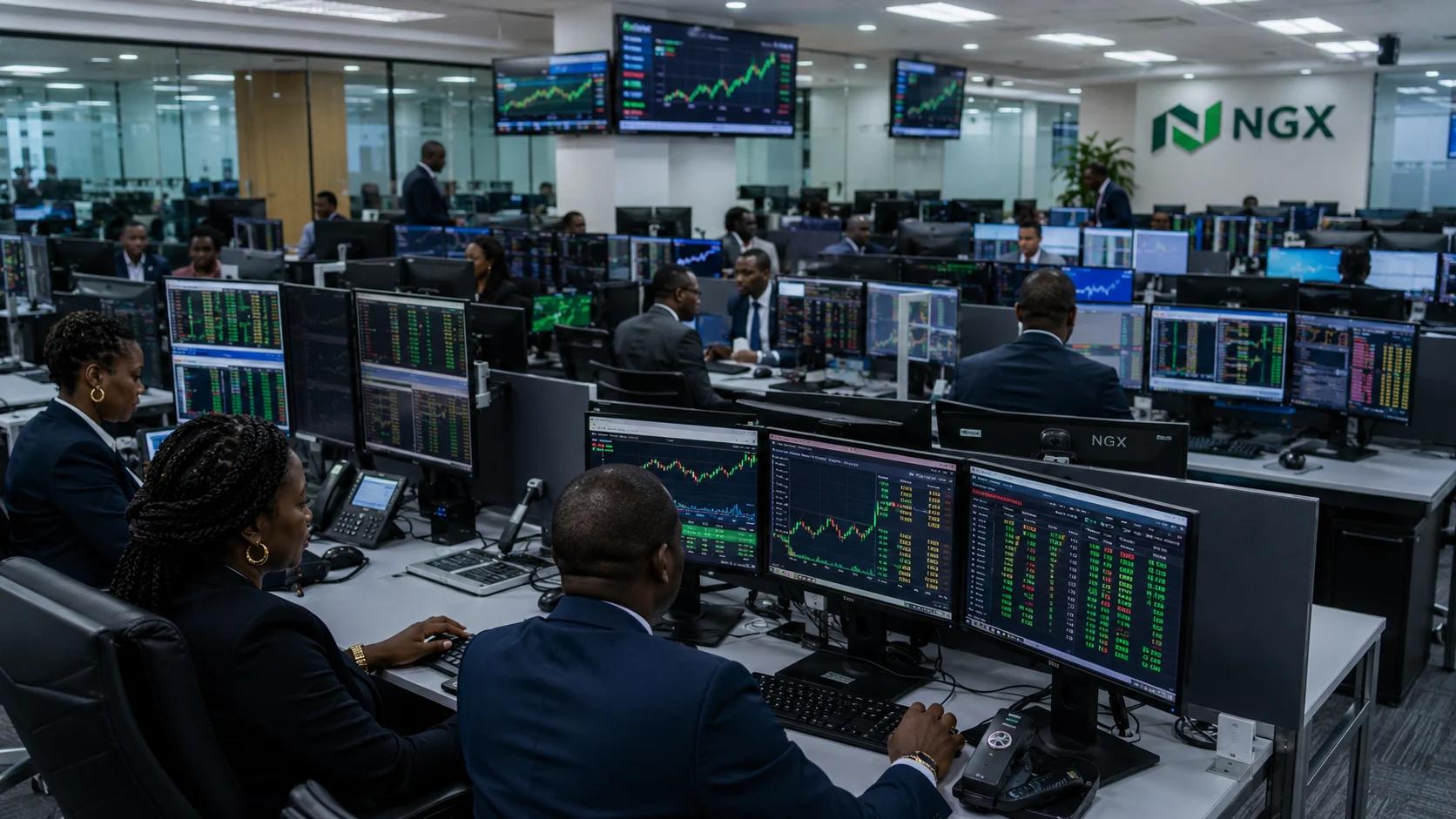
Nigeria’s equities market recovered on Tuesday as renewed buying interest in industrial, consumer-goods and selected banking stocks pushed the Nigerian Exchange’s main indicators higher.
The market capitalisation of listed equities rose by ₦410.86 billion, or 0.26 per cent, to ₦159.67 trillion at the close of trading. The All-Share Index gained 632.79 points to finish at 245,911.13 points, compared with 245,278.34 points recorded on Monday.
The figures were reported by Punch on Wednesday, October 21.
Industrial and consumer-goods stocks support recovery
The session’s performance was supported by gains in industrial and consumer-goods shares, alongside selected banking stocks.
The NGX Industrial Index advanced to 10,258.95 points from 10,140.51 points, while the Consumer Goods Index rose to 4,042.08 points.
The gains suggest that investors were willing to increase exposure to selected stocks after the preceding session’s losses. However, one positive trading session does not establish a sustained upward trend.
Market movements can reflect company-specific announcements, expectations about earnings, changes in interest rates and broader investor sentiment.
Market capitalisation recovers part of previous losses
The ₦410.86 billion increase in market capitalisation represents the change in the combined market value of listed equities during the session. It does not mean that the same amount of cash flowed into the market.
Market capitalisation changes primarily as share prices rise or fall, while actual trading flows depend on transactions between buyers and sellers.
For investors, the distinction matters because a market can record an increase in valuation without every listed company gaining or every shareholder making a profit.
The All-Share Index provides a broad measure of market performance, but investors should also examine individual stocks, sector indices and company disclosures before making decisions.
Interest rates and liquidity remain important influences
The session took place against the backdrop of the CBN’s 23 per cent Monetary Policy Rate. Interest rates can affect equity valuations by influencing borrowing costs, corporate financing expenses and the relative attractiveness of fixed-income investments.
High rates may place pressure on companies that depend heavily on borrowing, while businesses with strong cash flows and pricing power may be better positioned to withstand tighter financial conditions.
Investors will also be monitoring the banking system’s liquidity and the flow of funds into money-market instruments. These factors can affect the availability of funds for equity investments, although their impact varies across market conditions.
What investors should watch next
The latest recovery offers a positive signal for market sentiment, but investors will need further sessions of performance to determine whether buying interest can be sustained.
Upcoming company results, corporate actions, macroeconomic data and regulatory developments may influence trading in the coming days.
Investors should avoid treating a single-day gain as a guarantee of future returns. Decisions should be based on individual risk tolerance, company fundamentals, investment objectives and information disclosed through approved market channels.