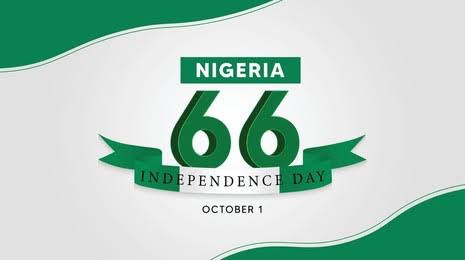
Nigeria is marking 66 years of independence today, October 1, 2026, celebrating more than six decades of nationhood and reflecting on a journey characterised by political transformation, economic expansion, technological innovation, cultural influence and resilience through repeated national challenges.
The country gained independence from British colonial rule on October 1, 1960, meaning today’s anniversary marks exactly 66 years as an independent nation.
The Federal Government declared Thursday a public holiday to commemorate the anniversary, while President Bola Tinubu is scheduled to address the nation as part of the official programme. The government opted for a relatively low-key celebration this year.
The anniversary provides an opportunity to measure Nigeria’s progress not simply by the passage of time, but by how far the country has travelled from the newly independent federation of 1960 to the complex democracy and economy of more than 200 million people that exists today.
From Independence to Africa’s Largest Democracy
Nigeria’s political history since independence has not followed a straight path.
The country has experienced military coups, decades of military government, a civil war between 1967 and 1970 and repeated political crises.
Yet one of its most significant achievements has been the preservation of a single federation despite its enormous ethnic, linguistic, religious and regional diversity.
Another important milestone came in 1999, when Nigeria returned to civilian democratic government.
More than 27 years later, the country has maintained uninterrupted civilian rule, with presidential, governorship, National Assembly and state legislative elections conducted periodically.
That record does not remove continuing disputes over electoral credibility, governance and political accountability, but it represents Nigeria’s longest uninterrupted period of democratic government since independence.
Nigeria’s progress over the decades includes milestones in democratic governance, infrastructure, telecommunications, financial services, education, healthcare and entrepreneurship, according to a review marking the anniversary.
Telecom Revolution Changes Everyday Life
Few sectors illustrate Nigeria’s transformation as dramatically as telecommunications.
At independence, modern communication infrastructure was accessible to only a small part of the population. Even decades later, obtaining a fixed telephone line remained difficult for many households and businesses.
The liberalisation of the telecommunications industry in the early 2000s transformed that landscape.
Mobile connectivity subsequently spread across the country, becoming critical infrastructure for commerce, communication, banking, entertainment and public services.
That telecommunications expansion also created the foundation upon which Nigeria’s digital economy has developed.
Today, smartphones and mobile networks support everything from digital payments and e-commerce to ride-hailing, entertainment streaming, online education and remote business operations.
Fintech Puts Nigeria on Global Technology Map
Nigeria has also developed one of Africa’s most prominent technology and fintech ecosystems.
Lagos has emerged as an important startup centre, producing companies operating across payments, banking technology, e-commerce, logistics, mobility and software.
Nigerian-founded technology businesses have attracted substantial international investment, while several have expanded operations across Africa and beyond.
The country’s digital financial-services industry has also transformed how individuals and businesses transfer money, receive payments and conduct transactions.
This represents a significant shift from an economy where financial services were once overwhelmingly dependent on physical bank branches.
The challenge for the next phase will be ensuring that technological innovation translates into wider productivity, sustainable employment and stronger locally owned technology companies.
Banking Sector Grows Beyond Nigeria
Nigeria’s financial industry represents another major area of expansion since independence.
Nigerian banks that once operated largely within domestic boundaries have developed operations across multiple African countries and, in some cases, international financial centres.
The Central Bank’s recently completed recapitalisation programme provides another indication of the scale of the modern financial system. According to figures disclosed this week by the CBN, 33 banks met revised minimum capital requirements and collectively raised ₦4.65 trillion.
The financial sector has also become increasingly digital, with electronic transfers, mobile banking and payment platforms now central to everyday commercial activity.
Infrastructure Expands Across Transport and Energy
Nigeria’s physical infrastructure has also changed substantially since 1960.
Successive governments have developed roads, airports, ports, power infrastructure and rail networks connecting different parts of the federation.
More recently, modern rail services have been developed on corridors including Abuja-Kaduna and Lagos-Ibadan, while major highway and port projects have continued.
The country’s refining landscape has also begun changing following years of dependence on imported petroleum products despite Nigeria’s position as a major crude producer.
The Federal Government says domestic refining capacity has expanded and lists infrastructure, energy, agriculture, education, digital skills and enterprise among areas receiving investment under current reforms.
Nigeria is also expanding compressed natural gas infrastructure as part of attempts to provide alternatives to petrol-dependent transportation. The Presidency says several states have begun deploying or expanding CNG-powered transport fleets and conversion programmes.
Nigeria’s Culture Becomes Global Export
One of the country’s most visible achievements has occurred outside traditional economic sectors.
Nigerian music, film, literature, fashion and visual arts have developed increasingly international audiences.
Afrobeats has become a major global music movement, with Nigerian performers appearing on international charts, filling major venues and collaborating with some of the world’s most prominent artists.
Nollywood has similarly grown into one of the world’s most prolific film industries, while streaming platforms have expanded the international distribution of Nigerian productions.
Nigerian writers, designers, visual artists and other creatives have also strengthened the country’s cultural presence internationally.
That influence has given Nigeria significant cultural reach far beyond its borders.
Economy Shows Signs of Stronger Growth
Nigeria’s economic journey has been more complicated.
Oil transformed public finances after independence, but dependence on crude exports also exposed the country to international commodity cycles and contributed to decades of efforts to diversify the economy.
Today, services, telecommunications, agriculture, manufacturing, finance, entertainment and technology all contribute to economic activity.
The Federal Government says real GDP expanded by 4.43 per cent in the second quarter of 2026, compared with 4.23 per cent in the corresponding period of 2025.
Officials have also pointed to stronger foreign reserves, increased domestic refining capacity and improving investment and productive activity as evidence of progress following recent economic reforms.
Those official assessments, however, coexist with the continuing pressures experienced by many households and businesses.
Achievements Exist Alongside Major Challenges
Nigeria’s 66th anniversary is consequently not only a celebration.
The country continues to confront insecurity, poverty, unemployment and underemployment, infrastructure shortages, electricity constraints and pressure on household incomes.
Education and healthcare outcomes remain uneven, while millions of Nigerians continue to seek better access to basic public services and economic opportunities.
The cost of living has also been an important concern during the country’s recent economic reforms.
The Federal Government itself has acknowledged that Nigerians have borne significant costs from structural adjustments and says the next stage of its programme is intended to translate macroeconomic improvements into jobs, higher incomes, wider access to credit and education, and improved living standards.
The difference between improving national economic indicators and the daily experience of ordinary citizens will therefore remain one of the central measures of progress beyond the 66th anniversary.
Nigeria at 66: The Next Chapter
At 66, Nigeria’s story remains one of enormous potential existing alongside substantial unfinished work.
From surviving civil war and military rule to establishing its longest period of democratic government, building major financial and telecommunications industries and becoming a global cultural force, the country has recorded significant achievements since the Union Jack was lowered in 1960.
Yet independence was never intended to be measured only by the number of years since colonial rule ended.
Its deeper measure lies in whether Nigerians can participate in a secure, productive and prosperous country capable of providing opportunity across generations.
As the green and white flag flies across the federation today, Nigeria celebrates 66 years of sovereignty — while entering another year in the continuing effort to convert its vast human, cultural and natural resources into broader prosperity for its people.