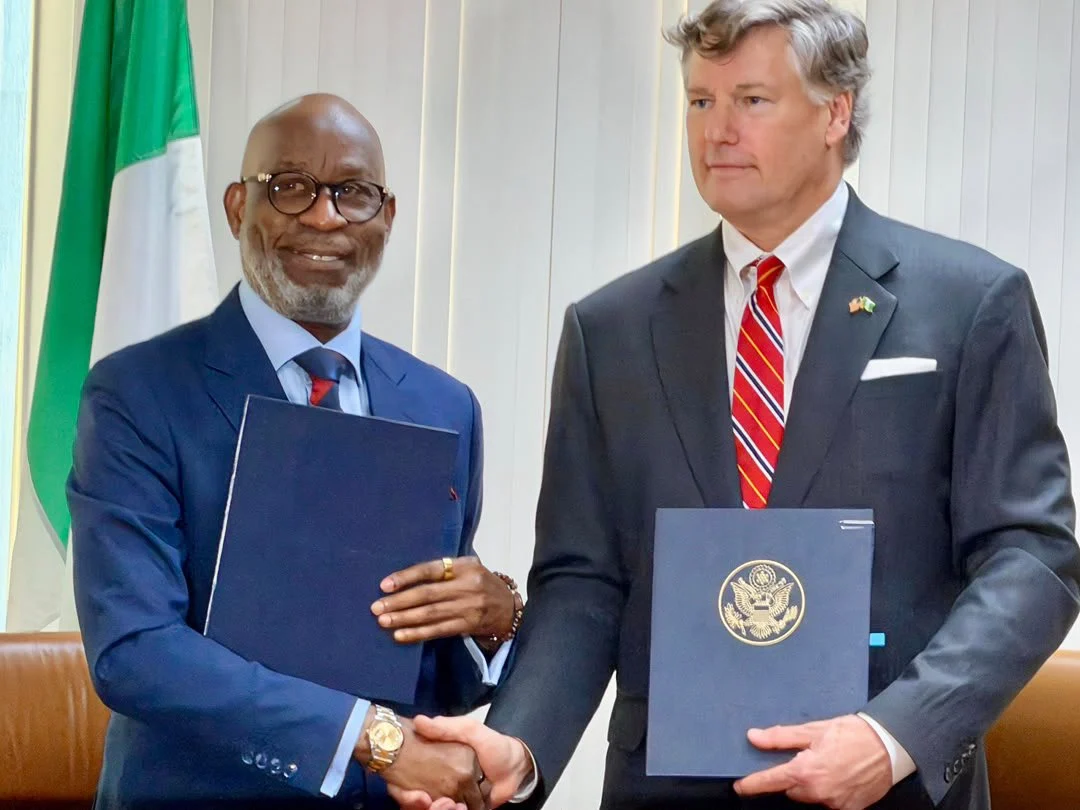
Nigeria and the United States have signed a new cooperation agreement aimed at attracting American investment into Nigeria’s solid-minerals industry and increasing the amount of value created locally from the country’s mineral resources.
The agreement establishes a framework for cooperation covering geological data and exploration, mineral development and processing, infrastructure and technical capacity building.
Nigeria’s Minister of Solid Minerals Development, Dele Alake, and US Deputy Secretary of State Christopher Landau signed the agreement at the Nigerian Mission House in New York on the sidelines of the 81st United Nations General Assembly.
Nigeria Wants More Minerals Processed Locally
Nigeria is widely known internationally as an oil and gas producer but also possesses deposits of lithium, gold, tin, iron ore, gemstones and other minerals.
The government is attempting to increase mining’s contribution to the economy by attracting capital while encouraging more domestic processing.
Lithium has attracted particular attention because of its importance in rechargeable batteries used in electric vehicles, energy-storage systems and consumer electronics.
Alake described the agreement as a framework capable of supporting business-to-business transactions and investment across the mineral value chain.
He said Nigeria wanted to move beyond serving primarily as a source of raw materials and instead develop processing capacity that creates jobs and skills domestically.
Geological Data Critical to Investment
Reliable geological information is particularly important to mining investors.
Unlike industries where assets are immediately visible, mining companies must understand the location, size, grade and commercial viability of mineral deposits before committing substantial capital.
Improving geological data can therefore reduce some of the uncertainty facing potential investors.
Infrastructure will be another major factor.
Commercial mines require power, roads and other logistics infrastructure to move minerals from extraction sites to processing facilities and markets.
The two countries are expected to identify viable projects as they move from the cooperation framework towards specific investments.
For Nigeria, the ultimate test will be whether the agreement results in new mines, processing facilities, jobs and Nigerian participation across mineral value chains rather than remaining primarily a diplomatic framework.