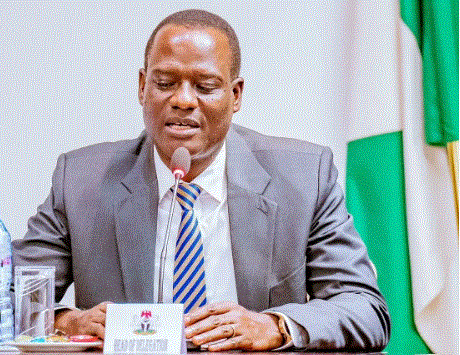
Nigeria’s Minister of Finance and Coordinating Minister of the Economy, Taiwo Oyedele, has called for stronger fiscal federalism, greater accountability and improved cooperation among the Federal Government, states and local governments.
Oyedele made the call on Monday, August 17, 2026, in Owerri, Imo State, at the 2026 National Council on Finance and Economic Development (NACOFED) Retreat.
The retreat, which runs from August 16 to 20, is themed “Strengthening Fiscal Federalism for Equity, Sustainable Development and Economic Resilience in a Volatile Global Economy.”
The minister said Nigeria’s three tiers of government must take greater responsibility for managing public resources and creating sustainable sources of revenue.
According to Oyedele, increased revenue allocations should translate into better infrastructure, human capital development, improved productivity and stronger public services.
He therefore challenged state governments to move beyond dependence on allocations from the Federation Account by improving their internally generated revenue, attracting private investment and creating jobs.
The minister’s position comes as Nigeria continues to implement fiscal reforms aimed at strengthening public finances and improving the management of government revenue.
Official figures show that the Federal Government, the 36 states and the 774 local governments shared ₦2.551 trillion in Federation Account revenue for June 2026. The amount comprised ₦1.810 trillion in statutory revenue and ₦740.724 billion from Value Added Tax.
Oyedele stressed that revenue increases alone would not guarantee economic development if governments failed to use available resources efficiently.
He also advocated prudent borrowing and greater transparency in public finance, warning governments against accumulating liabilities without credible plans for repayment.
The minister further said the current fiscal environment had improved to the extent that, according to him, no Nigerian state is presently struggling to pay salaries. He attributed the development to fiscal reforms and improved management of Federation Account revenues.
At the retreat, discussions also focused on the need to review Nigeria’s fiscal architecture, including allocation and derivation principles, while strengthening the capacity of states to generate and manage revenue.
Imo State Governor Hope Uzodimma, represented at the event by Deputy Governor Chinyere Ekomaru, similarly called for greater economic diversification.
The state government highlighted investments in agriculture, the digital economy, tourism, power, education, small and medium-sized enterprises and infrastructure as part of its strategy to expand economic opportunities and create employment.
The message from the retreat is clear: Nigeria’s fiscal sustainability will increasingly depend on how effectively the different tiers of government can generate revenue, control expenditure and invest in productive sectors.
For states, the challenge is particularly significant. Stronger internally generated revenue and diversified local economies could give governments greater financial independence while reducing vulnerability to fluctuations in federal revenue.