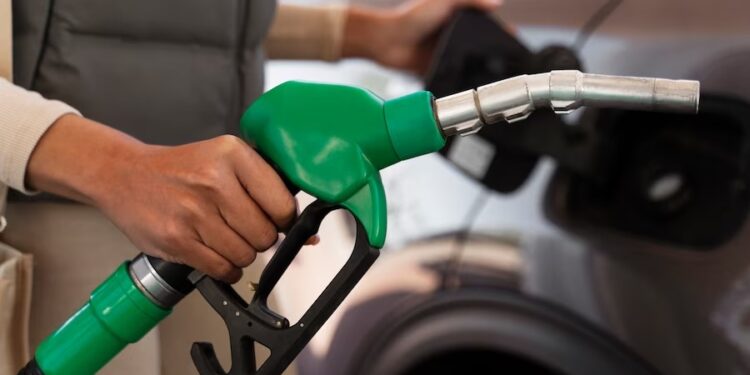
The price of Premium Motor Spirit (PMS), popularly known as petrol, has surged by about 643 per cent in the last three years, rising from N175 per litre in May 2023 to as high as N1,300 in May 2026.
The sharp increase followed the removal of fuel subsidies by President Bola Tinubu shortly after he assumed office on May 29, 2023. The decision marked a major shift in Nigeria’s petroleum pricing policy and triggered a wave of economic adjustments across the country.
Immediately after taking the oath of office, Tinubu declared that “the fuel subsidy is gone.” The announcement led to an instant increase in petrol prices, with pump prices jumping from about N175-N200 per litre to over N500.
The situation worsened following the floating of the naira in June 2023. As the local currency depreciated against major foreign currencies, the cost of importing petrol increased significantly, pushing pump prices beyond the reach of many Nigerians.
For several months, the Nigerian National Petroleum Company Limited (NNPCL) sold petrol below its landing cost through what the International Monetary Fund described as an “implicit subsidy.” While the actual landing cost exceeded N1,000 per litre, the product was sold at nearly half the price.
The former Chief Financial Officer of the NNPCL, Umar Ajiya, later admitted that the government had been covering the shortfall between the import cost and the regulated selling price.
Following the disclosure, petrol prices climbed further, reaching over N1,000 per litre in parts of the country.
Relief appeared to come in late 2024 when the Dangote Petroleum Refinery commenced the sale of petrol. The refinery’s entry into the market sparked competition and triggered a price war among marketers.
As a result, petrol prices declined and hovered between N800 and N900 per litre for several months.
However, the recent escalation of tensions in the Middle East has reversed those gains. Concerns over disruptions to global oil supplies, particularly around the Strait of Hormuz, pushed crude oil prices higher and increased the cost of refined petroleum products.
Since the outbreak of the US-Iran conflict in February 2026, the Dangote refinery has repeatedly adjusted its gantry price upward. Consequently, filling stations across the country now sell petrol for between N1,300 and N1,400 per litre, depending on location.
The latest increase has renewed inflationary pressures on the economy. Transportation costs have risen sharply, while the prices of food and other essential goods continue to climb.
In response to the growing burden on consumers, the Federal Government introduced the Presidential Initiative on Compressed Natural Gas (CNG) to encourage the adoption of alternative fuels.
Despite the programme, many Nigerians say the initiative has yet to significantly reduce transportation expenses or ease the cost-of-living crisis.
Economic experts have called on the government to introduce targeted interventions to support vulnerable citizens.
A former President of the Association of Energy Economists, Prof. Adeola Adenikinju, described the situation as a “two-edged sword” for Nigeria. While higher global oil prices could increase government revenue, he warned that rising fuel costs are worsening hardship for households.
According to him, targeted cash transfers would help cushion the impact on low-income Nigerians who are struggling with higher transport fares and rising inflation.
Similarly, the National President of the Petroleum Products Retail Outlet Owners Association of Nigeria (PETROAN), Billy Gillis-Harry, urged the government to use part of the gains from higher crude oil prices to reduce transportation costs and support citizens.
He warned that petrol prices could exceed N1,500 per litre if tensions in the Middle East continue to escalate.
Economist Bismarck Rewane also suggested that the Federal Government could consider selling crude oil to local refiners at agreed prices to prevent further increases in the cost of refined products.
However, the Federal Government has ruled out a return to fuel subsidies or the introduction of price controls.
Speaking during recent engagements with global investors in Paris, the Minister of Finance and Coordinating Minister of the Economy, Taiwo Oyedele, said the government would maintain its market-driven approach.
According to him, fuel subsidy removal remains irreversible, while price controls could create distortions in the economy.
“We will not bring back the fuel subsidy because it creates distortions for the economy, and we won’t introduce price control because we believe in the market,” Oyedele stated.
As Nigerians continue to grapple with rising fuel costs, attention remains focused on government policies, global oil market developments, and measures that could ease the pressure on households and businesses.