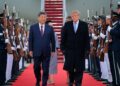
Global businesses and financial markets are closely watching talks between US President Donald Trump and Chinese President Xi Jinping on Thursday, with trade relations between the world’s two largest economies expected to feature prominently.
One of the major economic questions surrounding the September 24 meeting is whether Washington and Beijing will signal an extension of the trade truce reached last year, which helped prevent another major escalation in tariffs.
The meeting comes as China’s trade performance remains strong despite years of US efforts to reduce economic dependence on Chinese goods.
Reuters reported that more than half of the categories of Chinese products imported by the United States have increased compared with 2025, illustrating the difficulty of rapidly restructuring the commercial relationship between the two economies.
Businesses Want Stability
For multinational companies, the immediate issue is predictability.
Changes in tariffs can affect supply chains, sourcing decisions, consumer prices and investment planning across industries ranging from electronics and automobiles to machinery, retail and agriculture.
An extension of the existing arrangement could give companies additional time to adjust supply chains without confronting another immediate escalation in tariffs.
The talks are also taking place against a complicated geopolitical backdrop, including tensions over Taiwan and the ongoing Iran conflict.
China Arrives With Stronger Trade Position
Xi enters the meeting following continued strength in China’s international trade.
Beijing has increasingly diversified exports towards markets outside the United States, allowing Chinese manufacturers to reduce some of their dependence on American demand.
A Chinese business delegation is also accompanying Xi’s visit, potentially creating opportunities for commercial discussions alongside the political negotiations.
Expectations for a sweeping agreement remain limited, however. The immediate focus is instead on whether the two governments maintain enough stability in their economic relationship to prevent another damaging round of trade restrictions.
For global companies, the outcome matters far beyond the United States and China. The two economies sit at the centre of global manufacturing, technology, commodities and consumer demand, meaning changes in their trading relationship can quickly spread through supply chains and financial markets worldwide.