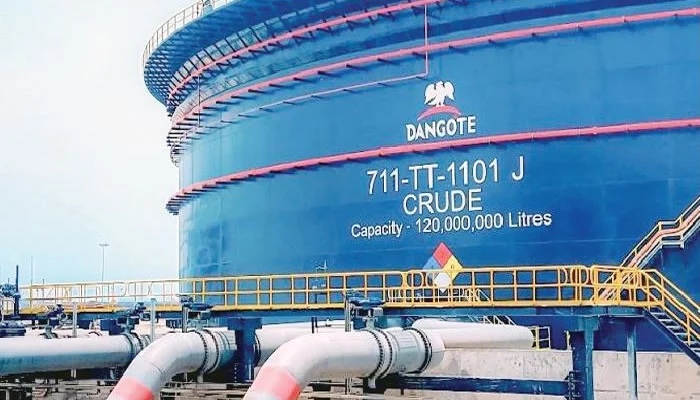
Dangote Petroleum Refinery has assured Nigerians that it will continue to supply fuel locally but warned that it may export refined products if it is forced to rely on imported crude oil for production.
The President of the Dangote Group, Aliko Dangote, made the disclosure during an interview with Al Jazeera, stating that the refinery is experiencing extremely high demand for petroleum products.
According to Dangote, the 650,000 barrels-per-day refinery located in Lekki has almost exhausted its supply of aviation fuel and diesel due to strong demand.
“The demand is so high. Today, we have almost sold out our jet fuel. We have almost sold out our gas oil. What we have is just the gasoline, which is the PMS. That’s the only one that we have in excess,” Dangote said.
The development has raised concerns among aviation operators and manufacturers who depend heavily on diesel and aviation fuel for operations.
However, a senior management official of the Dangote Group told journalists that the refinery would prioritise domestic fuel supply if the Federal Government ensures adequate crude oil supply to the facility.
“No! We will not starve Nigeria, as long as they keep giving us crude,” the official said.
The refinery had earlier complained that it receives less than five million barrels of crude oil monthly, far below the 19.7 million barrels required to run the plant at optimal capacity.
The official confirmed that discussions are ongoing with Nigerian National Petroleum Company Limited and other oil producers to resolve the supply gap.
He warned that if the refinery continues to import crude oil from international markets, it would have no choice but to export the refined products.
“If we have to import the crude, we will have to export the products,” he said.
Currently, the refinery produces about 75 million litres of petrol, 25 million litres of diesel, and 20 million litres of aviation fuel daily.
The facility has also begun supplying refined fuel to other African countries. Recently, it sold 12 cargoes totalling 456,000 tonnes of fuel to countries including Côte d’Ivoire, Cameroon, Tanzania, Ghana, and Togo.
Reports indicate that buyers from Europe, Asia, and South America are also competing to purchase products from the refinery.
Meanwhile, the refinery’s Chief Executive Officer, David Bird, said the company has been forced to purchase Nigerian crude oil from foreign markets at a premium price after it had initially requested the same crude locally before it was exported.
Speaking on a programme on Arise News, Bird explained that the refinery currently receives only five cargoes of crude per month, compared to the 13 to 15 cargoes expected under the Federal Government’s naira-for-crude supply agreement.
“What we see under that agreement, we should be getting about 13 to 15 cargoes a month… Currently, we’re only getting five. So that’s an underperformance against that pre-agreed volume contract,” he said.
Diesel prices surge
In a related development, Nigeria has recorded one of the sharpest increases in diesel prices globally amid tensions linked to the US-Iran conflict, according to new data from InvestorSight.
The data showed that diesel prices in Nigeria surged by 78.3 per cent since the crisis began, placing the country second globally behind the Philippines, which recorded an 81.6 per cent increase.
Other countries with significant increases include Malaysia at 57.9 per cent and Vietnam at 45.9 per cent.
The surge in Nigeria exceeded increases recorded in advanced economies such as the United States (41.2 per cent), Germany (30.9 per cent), and the United Kingdom (18 per cent).
Diesel prices in Nigeria have reportedly risen from about N900 per litre to N1,600 per litre since the Middle East crisis escalated on February 28.
Analysts warn that rising diesel prices could increase logistics and production costs, putting additional pressure on inflation as businesses pass the higher costs to consumers.
Despite these challenges, some industry marketers noted that fuel prices might have risen as high as N3,000 per litre if the Dangote refinery had not begun supplying refined products locally.