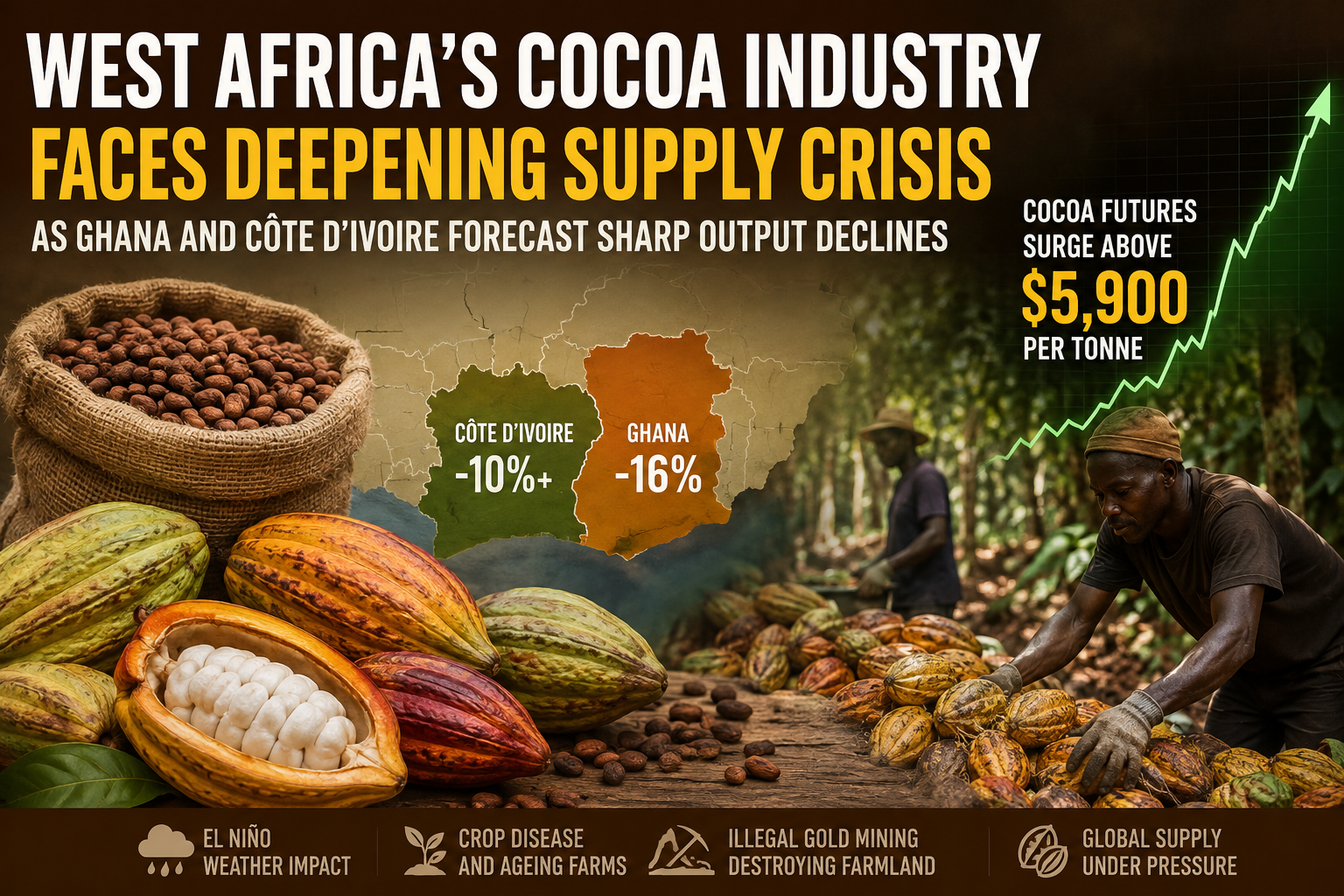
West Africa’s cocoa industry is heading into one of its most challenging seasons in recent history, with the region’s two largest producers—Ghana and Côte d’Ivoire—forecasting significant declines in cocoa production. The anticipated drop in output has already sent shockwaves through global commodity markets, pushing cocoa futures above $5,900 per tonne and raising fears of sustained supply shortages through 2027.
The two neighbouring countries account for approximately 60 percent of global cocoa production, making them critical players in the international chocolate and confectionery supply chain. Any disruption in their harvests has far-reaching consequences for manufacturers, exporters, farmers and consumers around the world.
According to the Ghana Cocoa Board (COCOBOD), cocoa production for the 2026/2027 crop season, which begins in September, is expected to decline by at least 16 percent. The projection follows a difficult growing season marked by adverse weather, plant diseases and environmental degradation that have weakened productivity across many cocoa-growing communities.
Neighbouring Côte d’Ivoire, the world’s largest cocoa producer, has also projected a production decline of more than 10 percent for the upcoming season, reinforcing concerns that the global cocoa market is entering a period of structural supply constraints rather than a temporary downturn.
The announcement immediately influenced commodity markets. Cocoa futures surged by more than 9.4 percent, climbing above $5,900 per tonne, their highest level since early July. Analysts say the price increase reflects growing concern among traders over tightening supplies from the world’s leading cocoa-producing region.
COCOBOD attributed Ghana’s projected decline to several interconnected factors.
One of the biggest challenges is the impact of the El Niño weather phenomenon, which has disrupted rainfall patterns and created prolonged periods of drought in key cocoa-producing areas. Scientists expect El Niño conditions to persist into late 2026 and early 2027, affecting multiple planting and harvesting cycles rather than a single season.
The regulator also cited the cocoa tree’s natural alternating production cycle, in which years of high yields are often followed by lower production seasons.
In addition, the spread of Cocoa Swollen Shoot Virus Disease (CSSVD) continues to threaten plantations across Ghana. The disease damages cocoa trees, significantly reducing yields and, in severe cases, killing entire farms.
Another major concern is the ageing of cocoa plantations. Many farms across Ghana were established decades ago and now require extensive rehabilitation or complete replanting. Older trees naturally produce fewer cocoa pods, making it increasingly difficult for farmers to maintain previous production levels.
Illegal gold mining, locally known as galamsey, has further worsened the situation.
Mining activities have destroyed thousands of hectares of fertile agricultural land, particularly in Ghana’s Western and Western North Regions, which together account for more than half of the country’s cocoa production.
Apart from destroying cocoa farms, illegal mining has polluted rivers and degraded soil quality, making large areas unsuitable for future agricultural production.
To address these challenges, COCOBOD has intensified rehabilitation programmes aimed at replacing diseased and ageing cocoa trees. The government has also reintroduced a nationwide free fertiliser distribution programme to improve farm productivity.
However, experts caution that restoring cocoa plantations is a long-term process.
Newly planted cocoa trees typically require three to five years before they begin producing commercially viable harvests. This means the benefits of current rehabilitation efforts are unlikely to be realised immediately.
While Ghana and Côte d’Ivoire struggle with declining production, Nigeria is pursuing a different strategy to strengthen its cocoa industry.
The Nigerian government recently announced a ban on the export of raw cocoa beans as part of efforts to encourage domestic processing into higher-value products such as cocoa butter, cocoa powder and chocolate.
Officials hope the policy will increase value addition within the country and help double cocoa processing revenues by 2030.
Industry analysts believe Nigeria’s approach could attract fresh investment into cocoa processing facilities, creating jobs and increasing export earnings while reducing dependence on raw commodity exports.
The tightening cocoa supply is expected to have significant implications for the global food industry.
Chocolate manufacturers, confectionery companies and food processors are likely to face higher production costs as cocoa prices continue to rise. Some businesses may be forced to absorb the additional costs, while others could pass them on to consumers through higher retail prices.
Supply chain experts advise manufacturers to review procurement strategies carefully, with many expected to increase hedging activities to manage price volatility over the coming months.
Investors are also closely monitoring developments in the cocoa market.
Although lower production generally reduces export volumes, higher international prices could improve farmgate earnings for cocoa farmers, provided governments maintain favourable pricing policies.
The recently signed Ghana–Côte d’Ivoire cocoa price harmonisation agreement, introduced in June, is expected to provide greater stability in producer pricing by promoting coordinated marketing strategies between the world’s two largest cocoa exporters.
However, analysts note that pricing reforms alone cannot solve the industry’s deeper structural challenges.
Long-term recovery will require sustained investment in climate-resilient farming practices, disease-resistant cocoa varieties, improved irrigation systems and stronger enforcement against illegal mining activities.
Agricultural experts also stress the importance of supporting smallholder farmers through access to finance, extension services and modern farming technologies that can improve productivity despite increasingly unpredictable weather conditions.
The current supply outlook serves as a reminder of the growing vulnerability of global agricultural markets to climate change and environmental degradation.
For businesses across the chocolate and food industries, the message from West Africa is becoming increasingly clear: cocoa supplies are tightening, production risks are rising and strategic planning will be essential to navigate what could become one of the most challenging periods for the global cocoa market in decades.
As Ghana, Côte d’Ivoire and other producing nations work to rebuild production capacity, stakeholders across the value chain will be watching closely to see whether ongoing reforms can restore stability to one of Africa’s most valuable agricultural exports.
Source: Reuters / Ghana Cocoa Board (COCOBOD)